
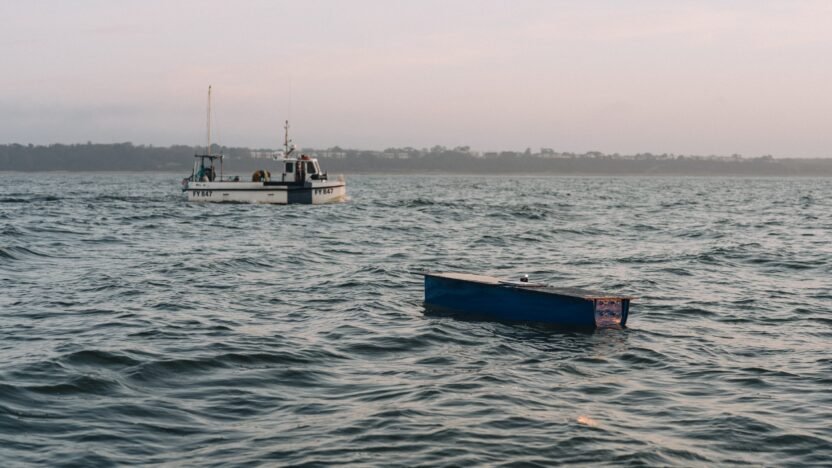
TAMPA, Fla. — Rising pressure to secure strategic waters is driving demand for more persistent monitoring of subsea activity, creating opportunities for satellite-connected autonomous vessels that can watch areas beyond the reach of space-based sensors.
British startup Online Oceans announced April 29 it had secured 4 million British pounds ($5.4 million) in seed funding to ramp up deployments for Scout, a solar-powered vessel it recently began delivering to customers.
Scout is designed to carry a wide variety of payloads, including cameras, weather instruments, acoustic sensors that listen for underwater activity and specialized modems that relay subsea data back via satellite networks.
The onboard data can also be accessed through Tether, Online Oceans’ cloud platform that is designed to control thousands of Scouts.
Early defense and government-adjacent customers for the one-year-old venture span the United Kingdom, the United States, the Nordics and Baltics across maritime domain awareness, submarine detection, critical infrastructure and broader ocean monitoring.
Online Oceans said it is also in active talks about deploying Scout for coastal and offshore security missions in the Gulf, where tensions around shipping lanes and energy infrastructure are increasing demand for persistent maritime awareness.
“Persistent maritime coverage has been too expensive for too long,” said Online Oceans cofounder and CEO George Morton, a former operations manager at ExxonMobil.
“That has limited what governments and operators can actually see, protect and respond to at sea. We built Online Oceans to change that. This funding allows us to scale production and support customers who need a far more practical way to monitor critical waters, protect infrastructure and maintain awareness over long periods.”
Fleet-scale surveillance
The startup said governments and infrastructure operators have long struggled to maintain cost-effective, continuous awareness with crewed or uncrewed vessels across subsea cables, offshore oil rigs, strategic chokepoints and other large maritime areas.
Scout is designed to be deployed in fleets for missions as long as six months — even during stormy weather, according to Maureen Haverty, an investment principal at space-focused investment firm Seraphim Space, which led the seed round.
Between 100 and 500 Scounts could support demining operations in a chokepoint such as the Strait of Hormuz, Haverty said, while more than 1,000 of them would be needed to support submarine detection across a larger area like the North Atlantic gap.
“Unlike other systems which are expensive and designed to follow a target or patrol, it’s cost effective to deploy thousands of Scouts as a fleet,” she said via email, without providing pricing details.
Scout relies on Iridium satellites for core communications and uses a modified Starlink terminal for high-bandwidth data.
“As investors, we consider this a great example of the next wave of Starlink-enabled products,” Haverty said.
“Starlink is enabling a small persistent platform to unlock new capabilities, a great example is piping back raw acoustic data in defense applications such as anti-submarine warfare, this hasn’t previously been possible pre-Starlink.”
Haverty described Online Oceans’ subsea capabilities as complementary to space-based geointelligence systems. Through a tip-and-cue model, satellites could also flag suspicious maritime activity for further investigation by Scout.
The seed round brings the startup’s total funding to around $6.7 million.