
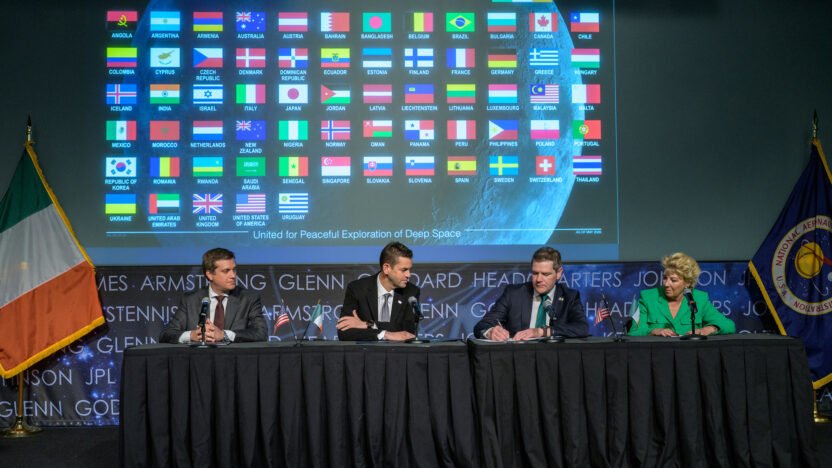
WASHINGTON — Two European countries signed the Artemis Accords May 4 as part of a surge of countries joining in the wake of the Artemis 2 mission.
In a ceremony at NASA Headquarters May 4, Peter Burke, Ireland’s minister for enterprise, tourism and employment, signed the Accords on behalf of the country. Ireland became the 66th nation to sign the Accords.
The Artemis Accords, unveiled in 2020, outline best practices for safe and sustainable space exploration, building upon the Outer Space Treaty and other agreements. NASA also increasingly sees the Accords as a vehicle for coordinating cooperation among countries in the Artemis lunar exploration effort.
Burke, in his comments at the signing ceremony, emphasized both. “I would think, first of all, that we need to continue to support this innovation, this exciting infrastructure that is core to communications, to our resilience, to security in so many fields of our endeavor. And secondly, that we work hard to ensure that we cooperate,” he said. “This is what the Accords are essentially about, that cooperative, responsible, transparent nature.”
The signing ceremony for Ireland took place hours after Malta signed the Accords at an event in the Maltese city of Kalkara. Clifton Grima, the country’s minister of education, youth, sports, research and innovation, signed the Accords in the presence of NASA and State Department representatives.
“This initiative strengthens our governance framework, enhances Malta’s international credibility and creates new opportunities to attract investment, build expertise and generate quality employment within the space economy,” Grima said in a statement.
With Ireland’s signing, all 23 full members of the European Space Agency have now joined the Accords. Four ESA associate members are also signatories, along with Canada, which has a longstanding cooperative agreement with ESA.
In addition, with Ireland and Malta signing, the only country among the 27 member states of the European Union yet to sign the Artemis Accords is Croatia.
The signings are part of a surge that has seen five nations join the Accords in 15 days. Latvia signed the Accords April 20 and Jordan on April 23, both in events at NASA Headquarters. Morocco signed the Accords April 29 in the Moroccan capital of Rabat.
Some have linked the surge to the success of the recent Artemis 2 mission as well as revised plans for the overall Artemis effort, such as development of a lunar base. “As the international community sees the success of the program as it moves forward, it’s only going to become more and more popular,” Mike Gold, president of Redwire Space and a former NASA official who helped lead development of the Accords, said in an April 29 speech.
The value of the Accords also came up during an April 29 hearing by a subcommittee of the House Foreign Affairs Committee on U.S. space security threats.
“The Artemis Accords benefit the United States because it brings everyone together on the shared principles of supporting the Outer Space Treaty,” said Mallory Stewart, chief executive of the Council on Strategic Risks and a former assistant secretary of state for arms control. “It coordinates our efforts toward a common goal of cooperation.”
“Our ability to cooperate with others expands our capacity to utilize, to benefit collectively from the outer space environment and to work collaboratively,” she said. “Having these kinds of concepts of the Artemis Accords, of other normative agreements with partners and allies, allows us to work together toward mutual benefit. And that is really important in the outer space arena.”