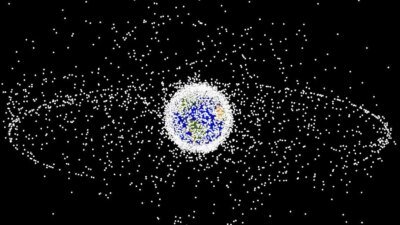
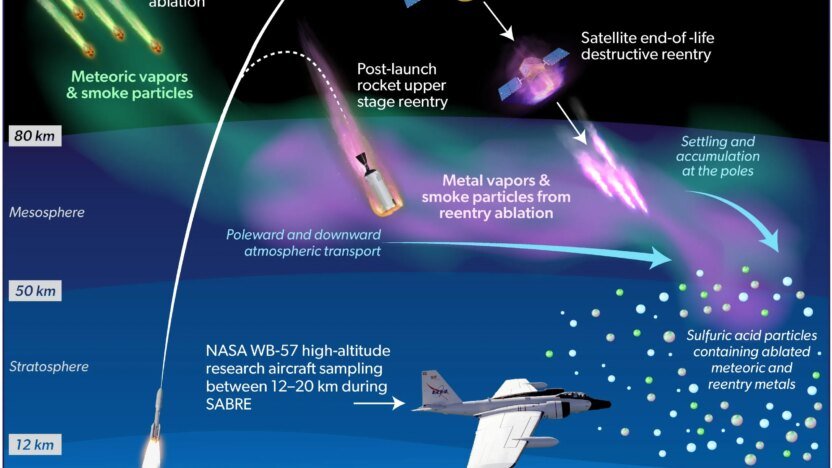
BOULDER, Colorado — Researchers are calling for increased attention and better protection against the rising introduction of exotic materials into Earth’s atmosphere from satellite and space hardware re-entry, especially in an era of megaconstellations.
At the 2026 European Geosciences Union held May 3-8 in Vienna, Austria, panelists raised questions about the atmospheric impacts of spacecraft launches and re-entries, along with research and policy priorities to promote environmental sustainability for space. The subject is also expected to be explored again at a National Academies gathering in July.
“This is a topic of increasing importance and concern for researchers working to understand the potential impact of a formidable space industry in the absence of regulation needed to prevent harm,” said session organizer Eloise Marais, a professor of atmospheric chemistry and air quality within the Department of Geography at University College London in the United Kingdom.
The conference included several research projects focused on determining the atmospheric impacts of space launch and reentry. Among the presentations and research directions reviewed were:
- New data from a team from the Leibniz Institute of Atmospheric Physics at the University of Rostock in Kühlungsborn, Germany, which used a three channel laser to scan the upper atmosphere for a variety of space debris metals.
- The proposed use of in-orbit mass spectrometers to measure tiny particles as tracers of larger space debris.
- An Earth Explorer program concept developed by ESA specialists called the CAIRT (Changing-Atmosphere Infra-Red Tomography) limb-imaging mission concept, which could provide the first global, vertically resolved observational constraints on aluminum oxide aerosols from space debris.
One concern for researchers is they feel they don’t have a strong understanding of what spacecraft materials are in use, making it difficult to determine whether and the degree to which they may be harming the Earth’s atmosphere. Daniel Baker, Director of the Colorado Space Policy Center here at the University of Colorado, Boulder, and a participant in the Vienna discussions, said that commercial companies are not keen on divulging what they utilize to fabricate spacecraft as they believe it’s a highly competitive matter. There’s also worry about having that information replicated by China or others, he said.

Jack Burns, associate director of the Colorado Space Policy Center, said that a lack of international regulations to curb debris growth and sustain the space environment creates ambiguities.
“Countries seem empowered to do whatever they want to do. Who is going to control and regulate in this international environment that we have evolved into?” Burns told SpaceNews.
“There is no guarantee that other players, rogue players, non-government players may cut corners and create bigger problems,” Baker said.
“This is a worldwide problem, not a national problem,” said Baker.