WASHINGTON — As SpaceX gears up to start launching orbital data center spacecraft as soon as next year, astronomers warn those satellites could cause serious interference with their observations.
In a June 12 interview on CNBC, SpaceX President Gwynne Shotwell confirmed that the company expects to launch its first data center satellites in 2027.
“I think we’ll be launching the full AI1 satellites late next year, but we will be putting compute on some of the Starlink broadband and the Starlink Mobile satellites prior” to that, she said in the interview, conducted as the company’s shares started trading on the Nasdaq exchange. Those earlier “canary sats,” she said, would test technologies planned for the orbital data center spacecraft.
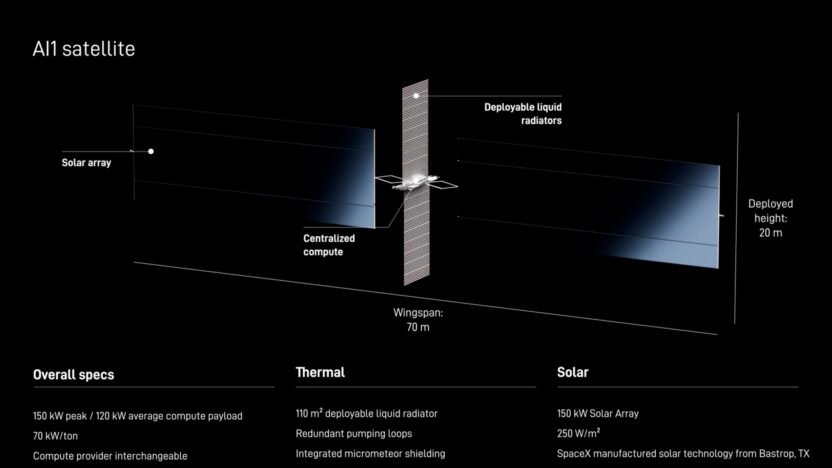
Earlier in the week, SpaceX provided more details about its orbital data center spacecraft, which the company calls AI1 after an earlier version, called AI Sat Mini, that the company discussed at a March event.
The satellite would be 70 meters long and 20 meters tall when its solar arrays and radiators are deployed. The arrays will generate up to 150 kilowatts of peak power, supporting an average of 120 kilowatts of computing payload.
“We like to look at this and say, what is the actual engineering problem here, and it’s really a combination of delivering power and then taking the waste heat and energy away,” said Ian Dahl, director of satellite engineering at SpaceX, in a video posted June 8.
SpaceX argues that the AI1 satellite will be easier to produce than its Starlink satellites because the AI satellites will not have complex phased-array antennas for communications, instead using laser intersatellite links to Starlink satellites.
“Given the two, the easier one to design for is the AI satellite,” said SpaceX Chief Executive Elon Musk in the video. “It’s a lot of solar panels, radiator, and then everything else is pretty small by comparison.”
SpaceX plans to build the AI satellites in Bastrop, Texas, east of Austin, where the company currently has a factory building Starlink terminals. Musk said construction of the facility that will produce solar arrays has started, to be followed soon by the factory for the AI satellites.
“We expect to have the AI sat production, the solar production and all of that operating at some reasonable volume by the end of next year,” he said.
Astronomy concerns
While SpaceX has the biggest ambitions for orbital data centers, having filed an application with the Federal Communications Commission in January for up to 1 million satellites, it is not alone. Several other companies have announced plans for constellations of data center satellites numbering in the tens of thousands of spacecraft.
Those proposed satellites come as astronomers continue to deal with the effects of broadband satellite constellations like Starlink. Since shortly after the first Starlink launches in 2019, astronomers have raised alarms that the brightness of those satellites could interfere with optical observations, while radio transmissions could affect radio astronomy.
Astronomers have worked with SpaceX and other constellation developers to reduce the brightness of those satellites, but with only partial success. At a June 4 National Academies meeting, Tony Tyson, distinguished research professor at the University of California, Davis, noted that despite those efforts, problems persist.
“SpaceX has set the standard for mitigation of satellite optical brightness,” he said. However, he noted that many of the current V2 Mini Starlink satellites have a brightness of fifth magnitude, higher than the recommended limit of seventh magnitude to limit impacts on telescopes like the Vera C. Rubin Observatory, where Tyson is chief scientist. The upcoming, larger Starlink V3 satellites will be even brighter, he added.
Plans for orbital data centers would make the problem even worse. “That creates a number of problems for us,” he said, given the number and size of the satellites.
One concern he identified is that the AI satellites would be launched into low parking orbits to be checked out before being raised to their operational orbits. The satellites are “extremely bright” while being tested in those orbits, he noted.
The high launch rates required to build out and later replenish the constellation will create “bright lanes” that will exist continuously in low Earth orbit. “These bright lanes are going to be a continuous feature that ground-based folks cannot avoid,” he warned. “At a million satellites, the sky brightness would be similar to the glare of a half-moon, which would preclude most of the science programs that our users want to do.”
Even in their higher operational orbits, the satellites can create glints as bright as Venus, with an average magnitude of about 0, he said. Those glints would interfere with time-domain astronomy, which monitors dynamic events like supernovas and gamma-ray bursts.
Tyson said he saw little sign of technical or policy changes to mitigate the impact from orbital data centers, although he offered his opinion that orbital data centers are a “failed business model” that will not be able to compete with terrestrial data centers using renewable energy.
“There’s going to be major impacts on optical astronomy from 2027 on,” he said. “The next young generation of astronomers is going to have to deal with this.”