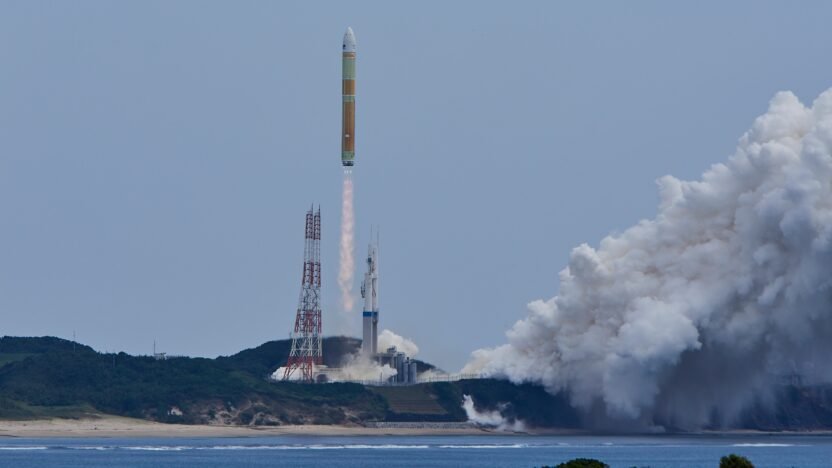
WASHINGTON — Japan’s H3 rocket launched June 11 on its first flight since a failure in December, placing six smallsats in orbit.
The H3 lifted off from the Tanegashima Space Center at 8:54 p.m. Eastern. The launch was the first flight of a new configuration of the rocket, the H3-30S, which has three LE-9 engines in its first stage rather than the two used on other configurations, but does not use any solid rocket boosters.
The launch was primarily a test flight of the H3-30S variant but carried six small satellites. Among them was BRO-22, a satellite from French company Unseenlabs that will join the company’s constellation of maritime tracking spacecraft.
Unseenlabs said BRO-22 was the first satellite not built in Japan to launch on the H3, a launch arranged by Japanese integrator Space BD. “This collaboration with Space BD & JAXA is important for Unseenlabs. Japan is a strategic partner for France, and also for Unseenlabs,” said Clément Galic, chief executive of Unseenlabs, in a statement before the launch.
While the launch was a test flight of this new version of the H3, it was also a return to flight for the rocket. The previous H3 launch in December failed to place its payload, the Michibiki 5 navigation satellite, into orbit. The failure was initially linked to a problem with the rocket’s upper stage.
An investigation by JAXA found that there were unusual shocks experienced by the vehicle when its payload fairing separated. That appeared to damage both the satellite and the payload adapter to which it was attached, causing parts of the adapter to damage the upper stage and puncture liquid hydrogen propellant lines, which likely caused the stage’s underperformance.
The investigation also found evidence that the payload itself fell off the payload adapter at the time of stage separation and thus never made it to space with the upper stage. Cameras on the rocket showed what appeared to be Michibiki 5 falling away from the upper stage after stage separation.
This was the eighth flight of the H3, a rocket intended to serve both commercial and Japanese government customers. There have been two failures of the rocket, including its inaugural launch in 2023.
The return to flight of the H3 clears the way for key missions, including the second HTV-X cargo mission to the International Space Station later this year and the launch of the Martian Moons eXploration, or MMX, mission to return samples from the Martian moon Phobos, scheduled for late this year.