
TAMPA, Fla. — Avanti Communications is moving to close a chapter on the debt-fueled geostationary expansion that once defined the British satellite operator, with plans to sell the youngest payload in its aging broadband fleet.
The company announced an agreement June 10 to sell its Hylas-3 Ka-band hosted payload to Japan’s Sky Perfect JSAT, which is in expansion mode and has three new satellites on order for geostationary orbit (GEO).
Financial details were not disclosed.
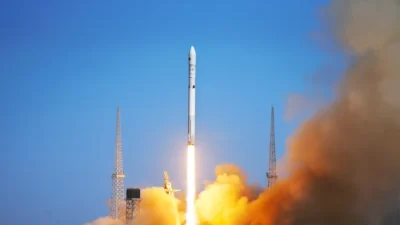
Launched in 2019 and operating at 31 degrees East over Europe, the Middle East, Africa and parts of Asia, Hylas-3 is on a spacecraft that also carries the EDRS-C payload for the European Data Relay System (EDRS).
A Sky Perfect JSAT spokesperson said the satellite would be relocated to cover more of Asia as part of the deal, “in coordination with relevant stakeholders prior to, or as part of, the transfer process,” without elaborating.
The European Space Agency, which uses EDRS-C to transmit data from Earth observation satellites to Europe in near-real time, referred questions to Airbus, the data relay network’s owner and operator.
Airbus and Avanti did not respond to requests for comment. The EDRS constellation also includes the EDRS-A payload carried on Eutelsat’s 9B satellite in GEO.
“Sky Perfect JSAT’s planned services will utilize the Ka-band communications payload; however, we are unable to disclose details regarding the other co-hosted payloads,” the Sky Perfect JSAT spokesperson said via email.
The spokesperson said the Avanti payload, to be renamed JSAT-144D, would bring its GEO fleet to 18 satellites, with three more in the pipeline.
Delayed growth
With eight steerable beams, Hylas-3 was once intended to help Avanti identify and cultivate new broadband markets ahead of its high-throughput Hylas-4 spacecraft.
However, Hylas-3 was already years behind schedule by the time Hylas-4 was deployed in 2018, when it helped ease capacity constraints after Avanti warned Hylas-1 and Hylas-2 were losing value faster than anticipated amid emerging competition over sub-Saharan Africa, the Middle East and Europe.
In another setback, Hylas-3 was finally deployed just months before the COVID-19 pandemic disrupted global connectivity and financial markets, slowing its initial rollout.
Hylas-1 is operating beyond its 15-year design life following deployment in 2010, while Hylas-2 was launched in 2012.
Citing insurance sources, SpaceNews reported in 2023 that Hylas-4 was operating with reduced power following an issue with onboard Power Processing Units that impacted thrusters on several satellites. Avanti said at the time that all its satellites were healthy and operating normally, but declined to elaborate.
The Hylas-3 sale follows mounting pressure on regional GEO operators from SpaceX’s Starlink and other low Earth orbit broadband (LEO) constellations.
Since a major refinancing in 2022, when Avanti investors agreed to swap debt for equity, the operator has shifted focus toward partnerships rather than large satellite procurements, including a deal to integrate Telesat’s planned Lightspeed LEO network with its GEO services.