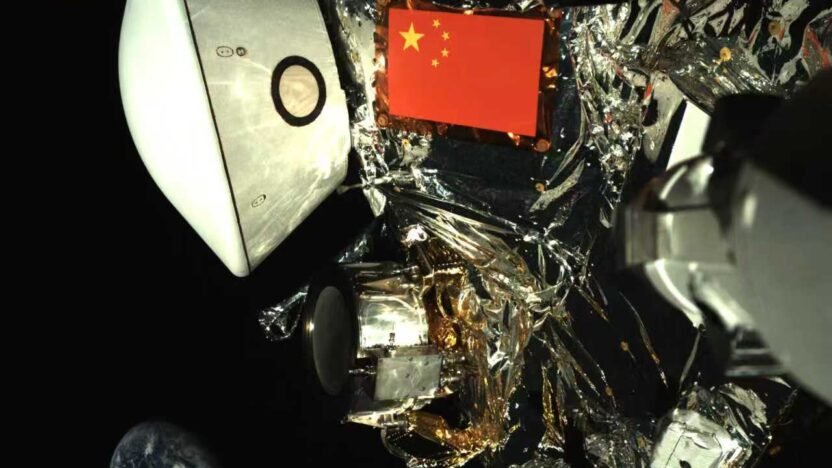
HELSINKI — China’s Tianwen-2 spacecraft has carried out a series of small propulsive maneuvers following a main burn June 7, setting up an asteroid rendezvous in July.
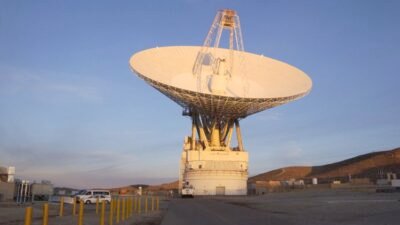
Doppler residual data collected by AMSAT-DL using a 20-meter dish in Bochum, Germany, and shared by observer PI9CAM June 14, shows a discontinuity in Tianwen-2’s tracked frequency June 11, suggesting one of a series of small burns.
The shifts are much smaller than that registered during the June 7 main burn, pointing to fine adjustments likely using the spacecraft’s ion electric propulsion system rather than its chemical thrusters.
Tianwen-2 launched May 29, 2025, and is headed to near-Earth asteroid 469219 Kamoʻoalewa (2016 HO3) to study the 40-100-meter-sized quasi-moon of Earth and collect samples. After delivering samples to the Earth, the spacecraft will use the flyby of the planet to set a course for main belt comet 311P, arriving in 2035.
The China National Space Administration (CNSA) has yet to provide an official update on the mission following the recent maneuvers. The June 7 maneuver occurred in line with an apparent mission timeline leaked shortly ahead of launch last year.
Despite the lack of official updates, the observed maneuvers fit the approach sequence described in Tianwen-2’s mission design. According to a paper by Zhang Rongqiao and colleagues published in SCIENTIA SINICA Physica, Mechanica & Astronomica, the spacecraft’s approach to Kamo’oalewa follows a planned sequence of phases, including the June 7 rendezvous, concluding when the probe has closed to within 20 kilometers of the asteroid’s surface, marking the starting point for close-proximity science operations. This will include global mapping and surveying and sample site selection.
A mission engineer, delivering a presentation on behalf of Zhang He at the 35th Meeting of the NASA Small Bodies Assessment Group (SBAG) June 11, confirmed Tianwen-2 is scheduled to arrive at Kamo’oalewa in July, without providing details on current distance from the asteroid.
Tianwen-2 carries a suite of 11 science payloads for studying both Kamoʻoalewa and its later target, the comet 311P/PANSTARRS, including cameras, laser ranging, spectrometers, sounding radar and particle analyzers. It also carries the DIANA dust analyzer from Italy.
Tianwen-2 will, partly because of the unknown nature of the asteroid and its surface mechanics, use three different sampling techniques, providing high levels of redundancy. These are hovering sampling, touch-and-go, and anchoring and attachment sampling. After collecting samples, Tianwen-2 will depart Kamo’oalewa in April 2027, delivering the samples via reentry capsule in late November 2027.
Kamo’oalewa rotates once every 28 minutes, presenting challenges to the mission. The asteroid could be a chunk of the moon blasted into orbit by a large impactor, or may have originated in the main asteroid belt.
The mission is the second in the Tianwen program, with Tianwen-1—China’s first interplanetary mission—successfully landing a rover on Mars in 2021. Tianwen-3 is a Mars sample return mission scheduled to launch in late 2028, while Tianwen-4 is a Jupiter system mission with a focus and potential landing on the Galilean moon Callisto.