Humans have always gazed up at the moon in wonder. A generation ago, NASA astronauts did the extraordinary and touched down on its surface, planting an American flag and igniting the world’s imagination for what space exploration could be.
In the decades that followed, our focus shifted. We built the International Space Station, and extended our reach into low Earth orbit (LEO). The moon, for a time, once again felt distant — something we had visited but not returned to.
But that chapter is over — and a new era of returning to the moon has begun.
America’s Artemis 2 astronauts just completed the first crewed lunar orbit in 50 years. This came after NASA’s Commercial Lunar Payload Services program celebrated breakthrough missions by Firefly’s Blue Ghost, and the world watched SpaceX take its company public. While the public tunes into this new space race, NASA and commercial space companies are already deeply involved — and it is increasingly clear that the moon is the great prize.
The moon is no longer just a place of scientific curiosity. It’s America’s next great economic frontier. Its surface may hold valuable resources, including water ice that can support sustained human presence, along with potential deposits of hydrogen, helium-3 and other materials that could enable entirely new industries beyond Earth.
But unlocking that future will require more than discovery. It will require capability — systems to land, operate, extract and sustain life in an environment that is still unforgiving and largely unexplored. And it demands the political will, especially in Congress, to preserve moon exploration programs.
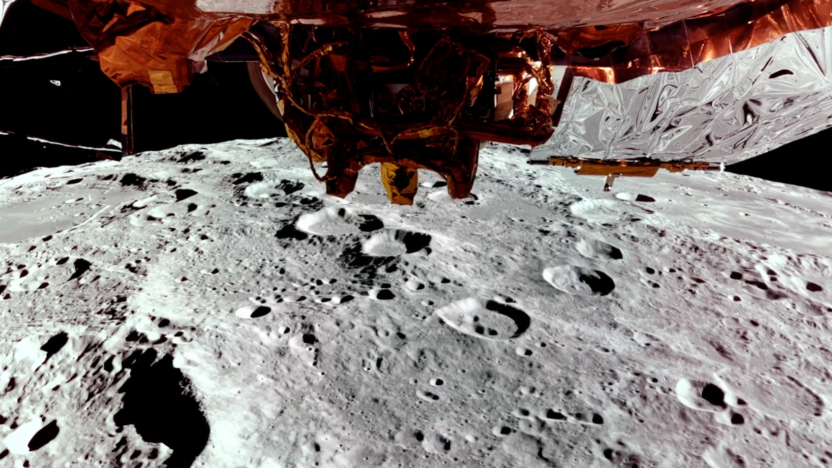
And in many ways, that challenge echoes the spirit of Apollo: a time when ambition, urgency and national resolve came together to achieve what once seemed impossible. I know because we just landed there. Just over a year ago on March 2, Firefly Aerospace put a commercial spacecraft on the lunar surface for the first time in history. Our Blue Ghost lander operated NASA science and technology instruments on the moon’s surface for more than two weeks. We drilled, sampled and surveyed. That data was beamed back to Earth, and we learned enough valuable lessons to take the next steps.
That model is repeatable and is now being replicated and scaled up by NASA and the commercial space industry. Another Firefly mission to the moon is planned within the year — this time targeting the far side, with an orbiter that will keep us continuously connected to territory no American spacecraft has reached before. And that’s just the beginning of repeatable missions to the moon.
We’re templating our Blue Ghost lander to support multiple science and discovery missions each year. We’re sending a fleet of our Elytra spacecraft to lunar orbit to unlock communications and imagery services. And we’re working towards a larger lander that can deliver even more infrastructure. This aligns with NASA’s call for monthly robotic missions and biannual crewed missions to enable a permanent moon base.
Mining rocks and building factories on the moon may still seem like science fiction to many, but here’s how it will unfold in the coming months and years. Missions are mapping the lunar surface — the regolith, mineral deposits, temperature extremes, viability of drilling and communications. The second step is infrastructure. Larger, next-generation landers will pre-position supplies, shelter, power systems and equipment before any humans set foot there. The astronauts will arrive and their tools will be waiting. They will man the structures and communications systems that form a permanent moon base and operations center.
The final phase is resource extraction and manufacturing. The moon’s gravity is one-sixth of Earth’s, which means launching material off the lunar surface is a fraction of the cost. Hydrogen and water ice could potentially be made into rocket propellant to power missions back to Earth or farther into space. The abundant helium-3 may prove useful for next-generation energy. And rare earth minerals can be leveraged for today’s technologies, such as batteries, smartphones and medical imaging, as well as technologies we are still inventing.
The economic benefits will be enormous. The global space economy reached $630 billion in 2023, and it is expected to reach $1.8 trillion by 2035, according to the World Economic Forum. The moon sits at the center. Lunar mining, resource extraction and manufacturing will drive that massive economic boom for those who develop the technologies and successfully deploy them.
Just recently, my young son asked me about our missions and what the future holds. He told me he doesn’t want to just visit the moon someday; he wants to live there. And the truth is, this isn’t far-fetched. But we must make it real by acting today. That means more robotic missions, investment in medium and large landers for lunar infrastructure and political will for NASA’s Moon Base initiative.
Congress must fully fund NASA’s Moon Base initiative and protect it from the budget volatility that forces commercial providers to plan in short sprints instead of long arcs. NASA should expand the Commercial Lunar Payload Services (CLPS) program — awarding more block-buy contracts, giving companies the certainty they need to invest in a more robust assembly line of next-generation landers, orbital infrastructure and resource operations. CLPS has already done for the moon what the Commercial Orbital Transportation Services program did for LEO: It has unlocked American commercial innovation, accelerated capability and proved the model works. Sustaining and scaling that program is the single most important step Washington can take. Every CLPS contract awarded is a down payment on American leadership in the lunar economy.
The Artemis 2 mission and our Blue Ghost Mission 1 lunar landing achieved incredible engineering feats and reignited interest in the moon. We now need to push ahead with bigger, bolder and repeatable space missions. The future lunar economy awaits. Humans will always be looking up at the moon. Soon they’ll be wondering about the people looking back.
Jason Kim is CEO of Firefly Aerospace, the first commercial company to successfully land on the moon. A U.S. Air Force Academy graduate and serial aerospace program executive, he is a leading voice in the American commercial space industry.
SpaceNews is committed to publishing our community’s diverse perspectives. Whether you’re an academic, executive, engineer or even just a concerned citizen of the cosmos, send your arguments and viewpoints to opinion (at) spacenews.com to be considered for publication online or in our next magazine. If you have something to submit, read some of our recent opinion articles and our submission guidelines to get a sense of what we’re looking for. The perspectives shared in these opinion articles are solely those of the authors and do not necessarily represent their employers or professional affiliations.