PADUA, Italy — Chinese startup Spark Space has secured a series of funding rounds for what it claims will be the world’s largest electric-pump-fed rocket, following engine tests.
Spark Space, established in 2024 and based in the city of Hefei, is developing the Jinhua-1, or Evolution-1, rocket. The rocket is to be powered by the self-developed Lieyan-2 electric-pump-fed engine, with Spark Space aiming for a debut flight in 2027.
The expendable Jinhua-1 is a two-stage rocket, measuring 27.5 meters long with a 2.25-meter diameter. Nine Lieyan-2 engines will power the first stage, with a single vacuum-optimized variant on the second stage, giving a liftoff thrust of 90 tons. The company states a payload capacity of 1,500 kilograms to low Earth orbit (LEO) and 1,000 kg to sun-synchronous orbit (SSO), while Rocket Lab’s Electron carries around 300 kg to LEO.
The company announced a Pre-A round of nearly 100 million yuan ($14.8 million) June 1, led by Yunze Capital and Orbital Chenguang, a space computing firm, then secured tens of millions of yuan from Cathay Capital in Pre-A+ funding announced June 18. Spark Space previously raised angel round and angel+ funding within the last 12 months, according to the company, with backing from a mix of private and Hefei government-linked capital.
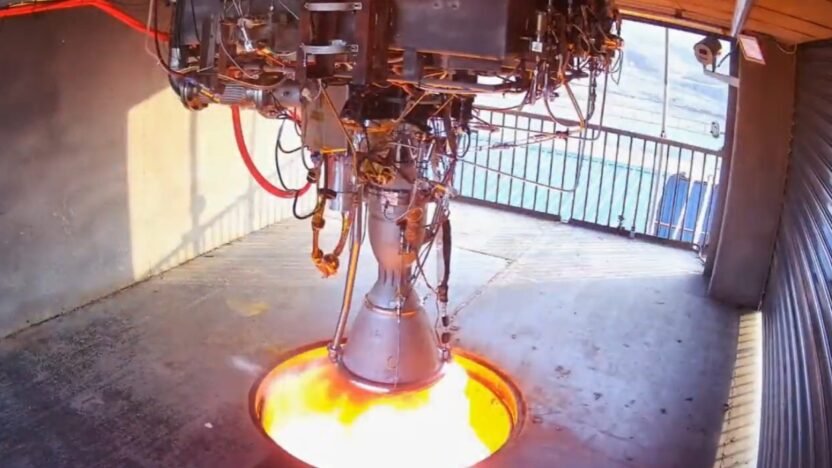
The funding follows progress on hardware. Spark Space announced the first successful test firings of the Lieyan-2 kerosene-liquid oxygen rocket engine in early March, verifying the design, ignition stability and vibration and pressure behavior under operation. While posting a 20-second clip, duration of the hot fire tests were not disclosed. Spark Space says its next milestones are engine reliability testing, first-stage propulsion system testing, and full rocket assembly and testing.
Spark Space’s Evolution-1 plan follows the path pioneered by the electric-pump-fed light-lift Electron rocket developed by Rocket Lab, which is the only electric-pump rocket to have reached orbit to date. Electron’s Rutherford engines deliver around 2.4 tons of thrust at sea level each, while Spark Space claims Lieyan-2 can produce 10 tons of thrust per engine. The electric-pump approach allows for a simpler, lighter engine, without the need for turbopumps and a gas generator. Those advantages don’t scale, however, with this approach having a disadvantage in terms of specific impulse and battery mass requirements. Rocket Lab switched to a gas generator cycle approach for its new, medium-lift Neutron rocket.
The company says production and testing operations are based at a facility exceeding 10,000 square meters in Hefei’s National High-Tech Industry Development Zone, with a 20,000 square meter expansion underway. Its technical team has experience with state giants the China Aerospace Science and Technology Corporation (CASC), China Aerospace Science and Industry Corporation (CASIC), and the Chinese Academy of Sciences (CAS), according to Chinese tech outlet 36Kr.
Spark Space is targeting contracts for satellite constellation deployment and replenishment, positioning Jinhua-1 as a low-cost, quick-response option for small and medium constellations.
Spark Space is setting an ambitious goal for reaching orbit next year, amid a crowded, competitive small launch market in China. Solid-fueled launch vehicles already flying regularly include Galactic Energy’s Ceres-1, CAS Space’s Kinetica-1 and Expace’s Kuaizhou-1A.