PORTLAND, Ore. – Boeing demonstrated a key quantum networking protocol in ground testing of a compact payload ahead of on-orbit experiment in 2027.
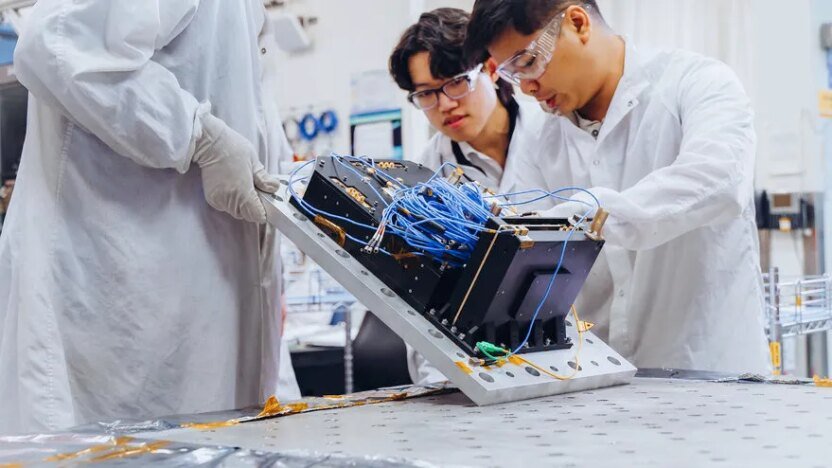
“High-fidelity entanglement swapping” was demonstrated earlier this year by Boeing’s Q4S quantum networking satellite system, Boeing announced June 18. After performing entanglement-swapping tests for more than a year, Boeing is now performing final integration of the Q4S mission.
“Quantum networking has the potential to transform how information is shared, timed and protected across global systems, but only if it can work outside the lab, under real mission constraints,” Lane Ballard, Boeing chief technology officer, said in a statement. “Q4S is about taking an important quantum capability and proving it on mission-ready hardware.”
There’s growing interest and funding for companies developing space-based quantum sensors, clocks and computers. Entanglement swapping, which relies on teleportation to extend links between entangled photon pairs, is a core building block of quantum networks.
“One of the hardest parts of quantum networking is maintaining strong performance while working within the size, weight and power limits of a spacecraft,” Jay Lowell, Boeing Quantum Systems chief scientist, said in a statement. “These test results show that we can produce high-fidelity swaps on a payload engineered for space, not just for a controlled lab bench. That is a meaningful step toward practical quantum networks.”
Boeing is paying for Q4S with independent research and development funding. Q4S, slated to conduct a one-year demonstration in orbit, to advance the company’s “long-term vision to enable a global quantum internet that connects quantum sensors and computing systems across vast distances,” according to the news release.
Technical results from the Q4S mission will be shared for peer review.
Boeing’s Q4S mission follows a July 2025 demonstration onboard the International Space Station of another quantum building block. At that time, NASA, the University of Illinois and Boeing showed that a payload in orbit could generate pairs of photons that remained entangled in microgravity.