WASHINGTON — Satellite servicing company Astroscale is working to transition from technology demonstrations to a regular series of missions, bolstered by a recent capital infusion.
The Tokyo-based company reported 11.5 billion yen ($71.1 million) in project income for its 2026 fiscal year, which ended April 30. That project income, which includes both contract revenue and government subsidies, was nearly double the 6.1 billion yen recorded in 2025.
Astroscale reported an operating loss of 10 billion yen for the year, an improvement from the 18.8 billion yen loss the company had in 2025, according to financial statements the company released June 12.
Both the income and operating loss were within the company’s forecast for the year. For the 2027 fiscal year that started May 1, the company is projecting project income in the range of 12.5 billion yen to 17 billion yen. However, the company expects its operating loss to remain about the same, from 9 billion yen to 9.9 billion yen.
“In the current fiscal year, we will continue to proactively strengthen our capabilities in talent, development and production. As a result, while we expect steady revenue growth, we also expect operating losses to remain at a similar level to the previous fiscal year,” Nobu Okada, chief executive of Astroscale, said in a presentation about the company’s financial results.
He said that reflects a strategy in which Astroscale, which so far has focused on demonstration missions to test rendezvous and proximity operations (RPO) technologies, shifts into commercial work with the prospect of “repeatable business opportunities,” particularly among defense customers.
“In the space sector, particularly in the emerging field of on-orbit servicing, the market tends to favor companies that move first to demonstrate technologies and accumulate operational track records,” he said. “Therefore, being a first mover globally in securing projects and building a track record in RPO will be a key factor in establishing long-term competitive advantage.”
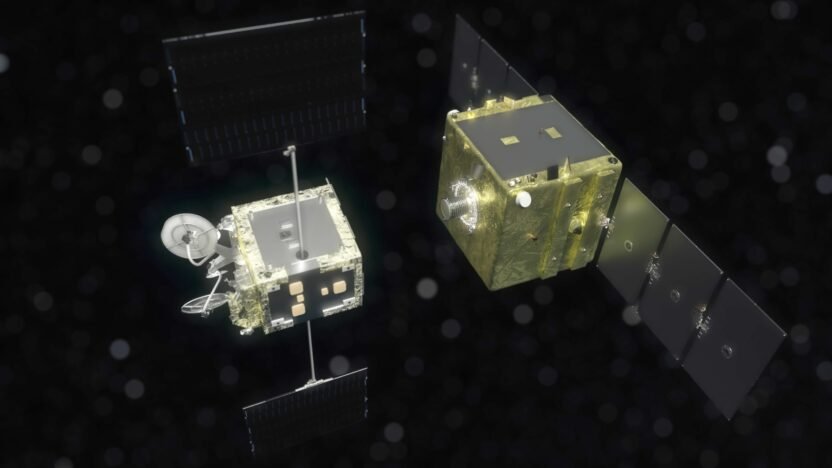
Astroscale has several such missions in development in Japan, the United Kingdom and the United States, ranging from a refueling mission for the U.S. Space Force to a demonstration of end-of-life disposal of satellites. Those missions are scheduled to launch in the next two years.
“By steadily executing these missions, we will further solidify our market position, leading to the expansion of repeatable business and, ultimately, mid- to long-term growth,” Okada said.
That business includes demand from defense customers in several countries that has “rapidly accelerated” in the last 18 months, he said, particularly in space domain awareness and spacecraft refueling. “We believe we are making steady progress toward securing repeatable business over this fiscal year and the next,” he said.
Among commercial customers, he said Astroscale sees a “significant market opportunity” in satellite life-extension services that would be provided by its LEXI-P spacecraft in development. The company is in negotiations with potential customers for that first mission, planned in its 2028 fiscal year.
The strategy of shifting from technology demonstrations to repeatable business is supported by new funding. The company announced in May that it raised 30.6 billion yen through a combination of convertible bonds and equity. Among those participating in the funding round were Japanese real estate company HULIC and satellite operator Sky Perfect JSAT.
Astroscale plans to use 7 billion yen of the new capital to expand production facilities in Japan and the U.K. and to enhance existing facilities. Another 7 billion yen will go toward manufacturing its LEXI-P spacecraft, with the rest used as working capital.
“Through these investments, we aim to establish a supply capacity capable of supporting repeatable business at an early stage while achieving both business growth and improved profitability,” Okada said.
That investment in facilities and production, he said, means operating losses will remain steady in the near term, but he called it “a deliberate step toward achieving our goal of making on-orbit servicing commonplace by 2030 and transitioning to a stable and highly profitable business model over the long term.”