
PITTSBURGH — Lunar lander developer Astrobotic decided to sell to Voyager Technologies so it could quickly scale up to meet the projected demands of NASA’s lunar base initiative.
Voyager announced June 2 that it reached an agreement to acquire Astrobotic for $162 million in cash and stock and the assumption of $9 million in debt. The deal includes up to an additional $129 million in earnout payments contingent on meeting performance milestones.
The announcement took many in the industry by surprise. Astrobotic is a 19-year-old company that had not relied on significant outside investment, choosing instead to bootstrap the company with customer contracts. That included NASA awards for the Peregrine lunar lander, launched in 2024, and its Griffin-1 lander, which the company unveiled June 15 for launch late this year.
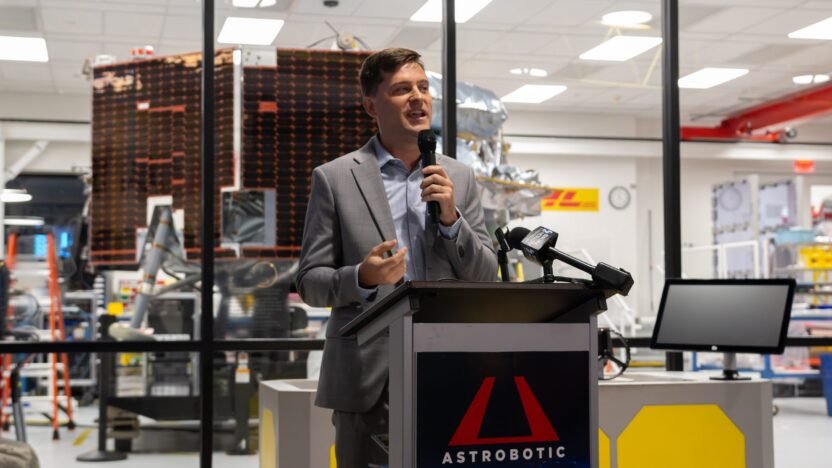
In an interview at the event, John Thornton, chief executive of Astrobotic, said the decision to sell the company to Voyager came after concluding that it was the fastest approach to scaling up the company to meet NASA’s needs after the agency announced its lunar base plans at the Ignition event in March.
“Fundamentally, we need to move fast,” he said. “With Moon Base coming out, we needed to scale, and we needed a partner that could do that, and Voyager is that in every way.”
Selling to Voyager, he said, would allow it to scale faster than if it took outside investment. “The alternate path would have been raise some money, maybe try to go IPO after that. That probably takes 18 months all in,” he said. “With the partnership with Voyager, we basically have access to public markets imminently when we close. That gives us an ability to scale now.”
The acquisition was part of Voyager’s “strategic lunar initiative” announced earlier this year that includes a much smaller investment in Max Space, a startup developing inflatable habitats that could be used as part of a lunar base.
“We’ve been mapping out the space infrastructure company for many, many years,” said Matt Magaña, president of defense and national security at Voyager, in an interview. He said what was attractive about Astrobotic was not just its lunar lander work but also its development of other lunar infrastructure, notably power systems.
“Every time that we mapped out what companies were there, what companies that we feel could be a great partnership,” he said, “Astrobotic was at the center of that map every single time.”
Neither Magaña nor Thornton said which company initiated the discussions that led to the acquisition. “We both saw it as a real strong strategic partnership and an opportunity to meet the moment,” Thornton said.
“We’re geared to move very fast. We’re geared to be partners with folks,” Magaña added.
Voyager said that Astrobotic would remain in Pittsburgh and become the center of Voyager’s overall lunar programs. Thornton said Astrobotic planned to expand its presence there.
“It’ll be a foundational change for us as a business, for Astrobotic, because for 19 years we’ve been basically living contract to contract, and piecing those contracts together into bigger things,” he said. “This is a fundamental game change for us, because now we can be strategic.”
“This is really what we needed in this moment with Moon Base. The opportunities abound, and if we weren’t ready to move at the speed that NASA needs, we would be left behind,” he concluded. “This is the perfect partnership to meet the moment.”