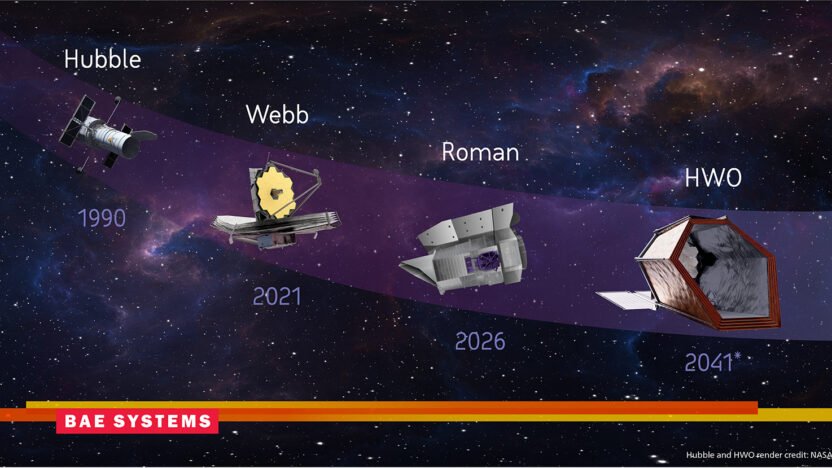
From observing distant galaxies to exploring exoplanets and their atmospheres, BAE Systems enables cutting-edge technology to expand our knowledge of the universe. As a major partner in each of NASA’s Great Observatories, BAE Systems is continuing the legacy of pioneering astrophysics missions with the next generation of observatories, including the Nancy Grace Roman Space Telescope (Roman) and the Habitable Worlds Observatory (HWO).
As we look to the future, we are leveraging our rich heritage of groundbreaking astrophysics technology development to provide the stability and resolution needed to investigate planets across the cosmos using deep imaging and highly multiplexed spectroscopy to search for habitable worlds like ours.
Current Astrophysics Flagship: The Nancy Roman Space Telescope
The Nancy Grace Roman Space Telescope, NASA’s next flagship observatory, will enable advances in astrophysics by providing a large-scale survey capability in infrared wavelengths. The observatory is designed to capture data that will allow astronomers to answer high-priority scientific questions related to the evolution and fate of the universe and the abundance of planets in the universe.
Roman Capabilities
- Complimentary to Webb and Hubble
- Roman has more than 100 times the field of view than Hubble, enabling the observatory to conduct comprehensive and efficient surveys of the infrared sky
- Roman will capture equivalent quality images to Hubble with the Wide Field Instrument
- Scientists estimate Roman has the potential to examine a billion galaxies over the course of its mission
- Roman will complete the census of exoplanets started by Kepler through a technique known as microlensing

NASA selected BAE Systems to design and develop the Wide Field Instrument (WFI) Opto-Mechanical Assembly for the Roman mission. The Opto-Mechanical Assembly provides the stable structure and thermal environment that enables the WFI to meet performance. It includes the optical bench, thermal control system, precision mechanisms (based on the James Webb Space Telescope’s primary mirror actuators), optics and electronics. Slated to launch this year, Roman’s large area surveys will provide scientists around the world, who will all have access to the observatory’s data, with a treasure trove of information in a fraction of the observation time previously required.
Future Astrophysics Flagship: Habitable Worlds Observatory
Are we alone in the universe? A question that serves as the north star for NASA’s Habitable Worlds Observatory (HWO). The HWO telescope is in the early stages of development and is focused on imaging earth-like planets orbiting other stars and searching them for signs of life. HWO would also provide a powerful lens to explore the stars, the planets of our solar system, galaxies, and the evolution of the universe with unprecedented sensitivity and resolution.
Observing exoplanets in detail presents a unique set of challenges. BAE Systems enthusiastically lends evolving expertise and architecture, gained through programs like Hubble and Webb, as HWO pushes technological and architectural boundaries.

Building off two previous NASA awards, BAE Systems is conducting a research effort called the Ultra-stable Large Telescope Research and Analysis Program – Critical Technologies (ULTRA-CT). ULTRA-CT will focus on developing “ultra stable” optical systems to support the observatory in capturing high-resolution images. BAE Systems was also selected to advance the next ULTRA research and development program with NASA, ULTRA-AT (Architecture & Technology). Each of the ULTRA phases allows our engineers to focus on different aspects of position control of key optics to the picometer level, which is 1000 times more precise than Webb. This transition will advance technology by three orders of magnitude to enable stability and discovery for future missions, including HWO.
Join our team
Looking to work where you can help make galactic discoveries?
Playing a major role in all of NASA’s Astrophysics Flagship missions, our team will continue to deliver solutions for complex NASA astrophysics programs that enhance understanding of our universe and galaxies.
Explore our careers website to find rewarding positions on our Space & Mission Systems team and see how your talent connects with our mission today. Don’t forget to join our talent community to set up job alerts, connect with our talent acquisition team, and receive career news and stories from BAE Systems.