MILAN — The European Space Agency will rely on external lunar topographic data during the design phase of its Argonaut lunar lander, and possibly for its first mission, while working toward developing its own lunar mapping capability for later missions.
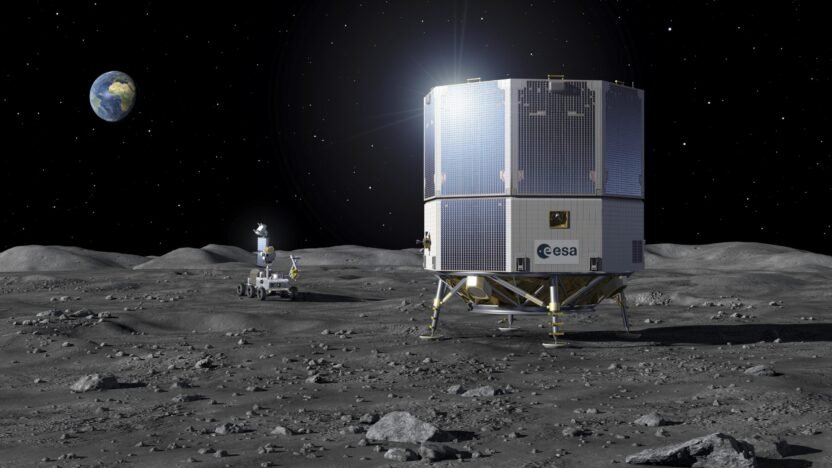
Argonaut, first proposed at ESA’s Ministerial Council in Paris in 2022 and confirmed at the latest ministerial meeting in 2025, is a cargo lander designed to support NASA’s Artemis program while providing Europe with independent access to the lunar surface.
Several spacefaring countries with lunar ambitions have invested over the past two decades in high-resolution topographic mapping, which is essential for identifying safe landing areas and potential sites for future lunar infrastructure.
Europe, however, does not have sovereign lunar topographic data to support Argonaut. That means ESA will need to rely on existing mission data, including data that can be procured from other providers, at least for the early phases of the program.
“We currently rely in the design phase on mission data which are already available, which can also be procured,” ESA director of human and robotic exploration Daniel Neuenschwander said during a June 17 briefing after ESA’s 347th Council meeting.
Albeit not confirmed, the three most likely nations that can provide lunar maps to Europe are the United States, India or China. NASA’s Lunar Reconnaissance Orbiter, launched in 2009, has provided global lunar topographic maps at about 100 meters per pixel, with targeted imaging down to about 0.5 meters/pixel. India’s Chandrayaan-2 Orbiter High Resolution Camera, launched in 2019, can image selected areas at about 0.25 meters/pixel, making it one of the highest-resolution lunar mapping instruments currently in operation. China, from Chang’e-1 onwards, has also built up a substantial lunar mapping capability to support future landing and exploration activities.
The cost of purchasing topographic data from third parties has not been disclosed.
“We have put lunar mapping as a key objective for future smaller lunar missions, which we are developing right now,” Neuenschwander added. “They are still competing among themselves, but two of them will focus on lunar data mapping of the south pole in particular to give us this database, which is absolutely key [to land on the moon].”
Argonaut is designed to deliver up to 1,500 kilograms of cargo to the lunar surface. Mission 1 is currently targeting a landing at the lunar south pole in 2030, with follow-on missions expected every two to three years.