WASHINGTON — Astrobotic, a developer of lunar landers and suborbital rockets, has successfully tested an advanced rocket engine that could power those vehicles.
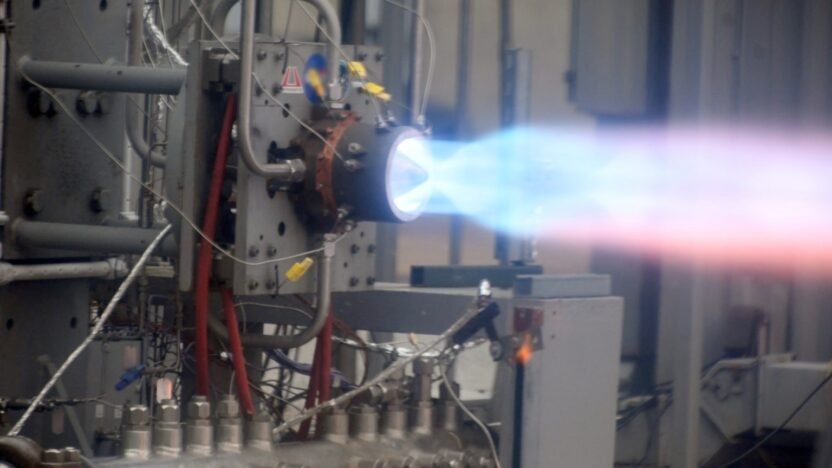
The Pittsburgh-based company announced April 23 it has completed a series of tests of Chakram, a rotating-detonation rocket engine, or RDRE, at NASA’s Marshall Space Flight Center. In those tests, two engine prototypes fired for a combined 470 seconds, including a single 300-second burn.
Astrobotic said the series of tests was a success, with no evidence of any damage to the engines during the firings. The engines produced more than 4,000 pounds-force of thrust in the tests.
An RDRE is an advanced engine technology where a detonation wave travels in a circle inside an engine at supersonic speeds. It promises higher performance than conventional engines, including increased specific impulse and thrust-to-weight ratios, but can be difficult to control. There have been many experiments in RDRE technology for spaceflight and hypersonic systems, but little flight experience.
The company said it believed the thrust level of Chakram was among the highest of RDREs tested to date, and the 300-second burn was the longest for such an engine.
Astrobotic said it was pleased with the outcome of the tests. “With any cutting-edge technology like an RDRE, moving from design into testing, you’re always worried about unknown factors that could be critical to performance, but the engine performed even better than expected,” said Bryant Avalos, principal investigator for the Chakram program at Astrobotic, in a statement.
The company said its work on Chakram was supported by two NASA Small Business Innovation Research awards and a Space Act Agreement with NASA Marshall. The company used the SBIR contracts to test additive manufacturing technologies that could help produce such engines.
“This was pulled off by a small group working on a modest budget. Seeing the engine perform flawlessly on its first attempt is a testament to their acumen, ingenuity and scrappiness,” said Travis Vazansky, Astrobotic’s RDRE program manager.
Astrobotic envisions using an engine like Chakram on future vehicles, including versions of its Griffin lunar lander. That lander is slated to make its first flight later this year.
The company also wants to use the engine on a series of suborbital vehicles. Astrobotic announced in December it won $17.5 million in NASA and military contracts to develop three new reusable suborbital vehicles based on designs it acquired in 2022 when it purchased the assets of bankrupt Masten Space Systems.
Astrobotic will continue development of Chakram, focusing on technologies needed for those lander and suborbital vehicle applications, such as regenerative cooling and throttling, as well as reducing the engine’s mass. The company did not estimate when Chakram would be ready for flight applications.