WASHINGTON — A month after a devastating pad explosion, Blue Origin reiterated its plans to return its New Glenn vehicle to flight from a rebuilt launch pad by the end of the year.
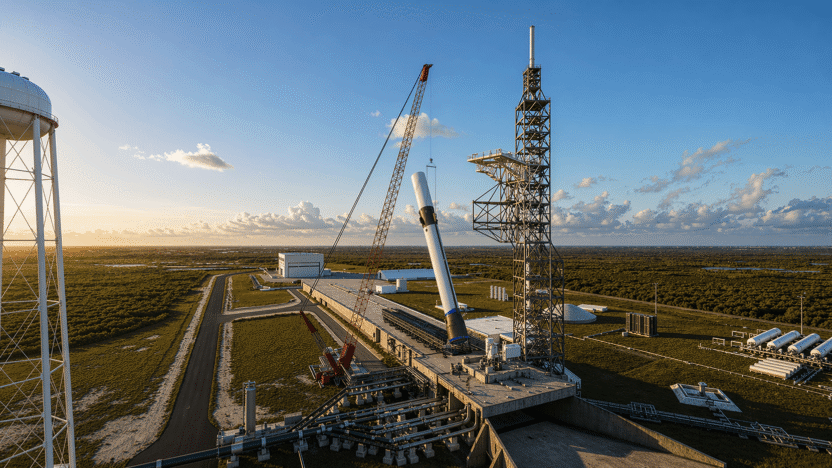
In a June 30 update, the company outlined the alternative approach, called a concept of operations, or CONOPS, it intends to use to transport the launch vehicle to the pad, replacing the transporter/erector destroyed in the May 28 explosion. That transporter/erector rolled the complete rocket out horizontally to the pad, raising it to the vertical position for launch.
“To return to flight this year, we’re not rebuilding the same pad. We’re going straight to a horizontal/vertical hybrid CONOPS we had already been developing for our 9×4 New Glenn launch vehicle,” wrote Dave Limp, Blue Origin’s chief executive, referring to the planned upgrade of New Glenn, “using existing infrastructure, skipping a new transporter-erector and creating a common CONOPS across two pads.”
The new approach involves transporting the vehicle, without the payload attached, horizontally from an integration facility to the pad. A crane raises the rocket to the vertical position and installs it on the pad. The payload is then rolled out and attached to the top of the rocket using the same crane.
That approach, Limp noted, was what the company planned to do for the larger New Glenn 9×4 rocket that would launch from a second pad, yet to be built, at Launch Complex 36, although the company had not previously disclosed those plans.
Limp said that new approach would enable New Glenn to resume launches from the rebuilt pad this year. “Our road to space doesn’t pause here. We will return to flight by the end of this year,” he wrote.
The company, though, has not disclosed what caused the rocket to explode on the pad. “We continue to actively investigate the cause of the anomaly,” he wrote. “Early analysis points to the aft section of the first stage.”
He did not elaborate on whether the investigation was focused on the stage’s seven BE-4 engines or other systems there. A problem with the BE-4 would have implications not just for New Glenn but also for United Launch Alliance’s Vulcan Centaur, which uses the same engine. Vulcan has not launched since February because of an unrelated anomaly with that vehicle’s solid rocket boosters.
A return to flight by the end of the year, or seven months after the explosion, would be a remarkably fast recovery. Similar events in the past, such as a Falcon 9 pad explosion in 2016 or an Antares launch failure just after liftoff in 2014, required a year or more of work to repair the damaged launch sites.
“We’ll see if they get back online before the end of the year. I think that’s pretty aggressive,” said Kelvin Coleman, former FAA associate administrator for commercial space transportation and founder of Baines Advisory Group, during a June 30 panel discussion by the Washington Space Business Roundtable. “But in the long run they will be there.”
NASA is counting on New Glenn to launch the Blue Moon lunar landers, the first of which was planned to launch later this year before the pad explosion. Agency officials said at a June 30 update on their lunar base efforts that they were confident New Glenn would return to flight by the end of the year or in the first half of 2027.
“We’ve been focused on helping Blue Origin with the determination of the root cause. We will help with building the infrastructure,” said Carlos García-Galán, NASA program executive for Moon Base.
“Blue Origin’s response to the situation is almost beyond impressive,” added NASA Administrator Jared Isaacman, saying that assessment was shared by the Space Force, which has also been involved in the response to the explosion.
“I get daily updates,” he said later in the briefing about Blue Origin’s recovery work. “We’ve embedded personnel into the pad recovery effort as part of the anomaly investigation.”
Both Isaacman and García-Galán said they were sticking with “Plan A” of launching Blue Moon landers on New Glenn after the agency said earlier in June it was evaluating alternative launch options for the landers.
“If they’re committed to getting back before the end of the year, great. It would be an amazing accomplishment if they did,” Isaacman said. “They can go beyond that. NASA is still fine up until a point,” which he said was around the middle of 2027 because of its impacts on the Artemis 3 mission. That mission includes docking an Orion spacecraft with a Blue Moon Mark 2 lander prototype in low Earth orbit.
“I think, based on the progress that we’ve been seeing so far and the great communication from Dave Limp on this one, we don’t have any reason to believe that we would have to select an alternative pathway yet,” he said.