HELSINKI — China completed its ninth and tenth launches of September, sending Guowang and Yaogan satellites into orbit, ahead of an intense finish to the year.
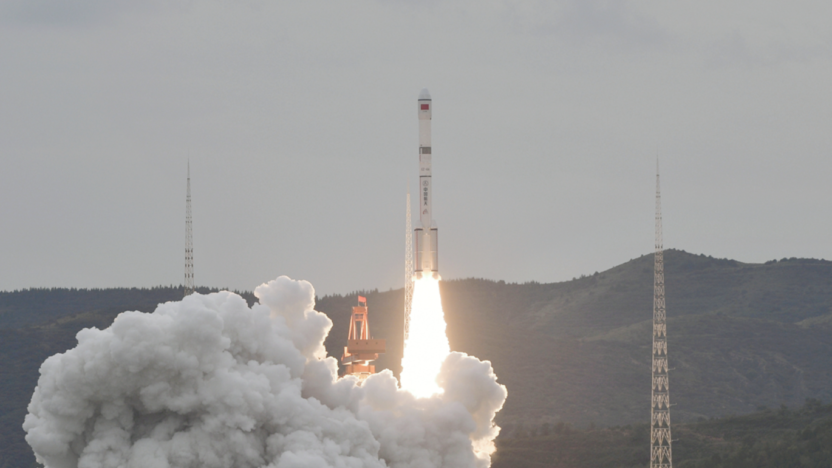
A Long March 8A lifted off at 9:32 a.m. Eastern (1332 UTC) Sept. 23 from the Hainan commercial spacecraft launch site, carrying the 26th group of satellites for China’s Guowang national low Earth orbit satellite internet project. Less than a day later, a Long March 6A lifted off at 4:46 a.m. Eastern (0846 UTC) Sept. 24 from Taiyuan Satellite Launch Center with the fourth group of Yaogan-40 satellites.
The pair of launches capped a September in which Chinese launchers flew at a pace that frequently saw multiple orbital missions within days, including four different rockets launching from three sites within 48 hours Sept. 15–16.
China Aerospace Science and Technology Corp. (CASC) stated the Guowang satellites had entered their planned orbits. The satellites were later tracked by U.S. Space Force in roughly circular 1,100-kilometer-altitude orbits inclined by 50 degrees. The batch was developed under the overall leadership of the China Academy of Space Technology (CAST), CASC’s main spacecraft maker, according to the corporation.
Guowang is run by China SatNet, a state-owned enterprise established in 2021, and is planned to comprise around 13,000 satellites. The constellation uses satellites from multiple manufacturers and is launched on a range of Long March vehicles, with the Long March 8A, which debuted in February 2025, now launching regularly from Hainan’s commercial pads.
The three Yaogan-40 (04) satellites will mainly be used for electromagnetic environment detection and related technology experiments, Xinhua reported, using boilerplate language typical of Yaogan launches. The satellites were also developed under CAST’s leadership.
The satellites entered near polar orbits with altitudes of around 800 km, joining three earlier batches in similar orbits. Analysis by Integrity ISR indicates that the Yaogan-40 groups are placed into orbital planes separated by 72 degrees in right ascension of the ascending node, suggesting a fifth group will be needed to complete the constellation.
The Long March 6A, a kerosene-liquid oxygen core with solid boosters, is one of CASC’s main vehicles for both Yaogan and megaconstellation missions from Taiyuan. The rocket has now flown 27 times since its debut in March 2022, with all flights successfully reaching orbit, though the upper stage has experienced a number of breakup events after payload deployment.
The pair of launches take China to 70 orbital launch attempts for 2026. With the country aiming to surpass 100 launches in a calendar year for the first time, the final quarter will see heavy activity. China launched 26 times in Q3, following 26 in Q2 and 18 in Q1, and would need to conduct at least 31 launches in Q4. The country’s annual launch schedule is typically backloaded with a greater number of launches later in the year.
Potential Q4 launches
One major mission will be Shenzhou-24. China’s next crewed mission now appears likely to launch around November, using a Long March 2F from Jiuquan. The crew is expected, though not officially confirmed, to include a Pakistani payload specialist, chosen from one of two Pakistan Air Force pilots in training at the Astronaut Center of China. The selected astronaut would become the first foreign astronaut to visit Tiangong.
A press conference a day ahead of the Shenzhou-24 launch may also provide updates or insights into the schedule for the first launch of the Mengzhou new generation spacecraft and the Long March 10A, both of which are related to China’s crewed lunar plans.
Possible debut launches include Orienspace’s Gravity-2, iSpace’s Hyperbola-3 with a first stage recovery attempt, and Zhihang-1 from Zenk Space, which earlier aimed for a launch in June. These would add to 2026 debuts including Tianlong-3 (April), Kinetica-2 (March), the Long March 12B (June), Long March 10B (July) and Pallas-1 (Sept. 1).
Numerous launches for the Guowang and Qianfan constellations are expected. Other notable possible payloads in the coming months include Fengxing-1 on a Gravity-1 solid rocket, which could be China’s first commercial orbital transfer vehicle, from Future Space. Also expected are space computing payloads. The schedule for the planned debut flight of the Haolong reusable spaceplane for cargo to Tiangong from AVIC on a Zhuque-3 rocket from Landspace is currently unknown.