HELSINKI — China’s secretive spaceplane has released an object into orbit during its ongoing fourth mission, according to space surveillance firm LeoLabs.
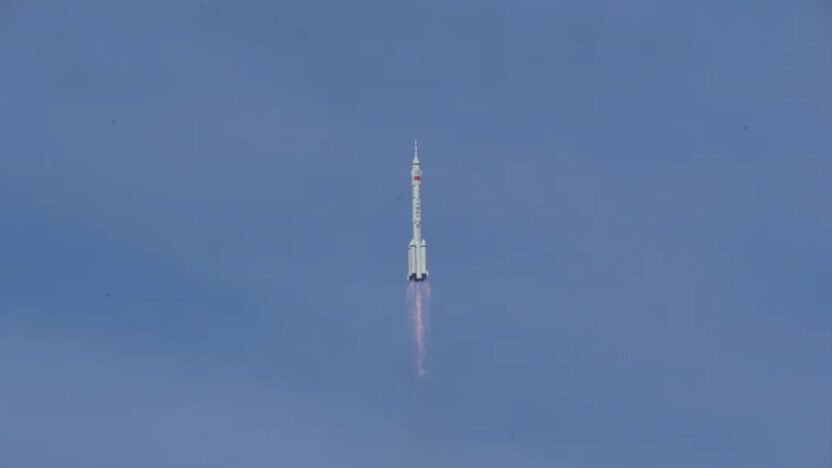
A Long March 2F rocket launched the orbital spaceplane into low Earth orbit from Jiuquan Satellite Launch Center in the Gobi Desert Feb. 7 local time. The spacecraft then raised its orbit to a roughly circular 593-kilometer altitude.
LeoLabs stated it detected an “unknown object in the vicinity of the Chinese Shenlong reusable spaceplane,” at 10:30 p.m. Eastern, June 21 (0230 UTC, June 22) in a June 22 post on social media platform X. The post stated that the object was first observed by LeoLabs’ Kiwi Space Radar tracking radar in New Zealand and did not correlate to any other object in the firm’s catalog.
“Following additional observations across our global network and analysis via LeoLabs Delta, we have independently cataloged this object and assessed with high confidence that it was released from the Chinese spaceplane,” the post read.
The object had not yet appeared in the Space-track catalog maintained by U.S. Space Force as of the time of reporting.
The detection of the object follows a pattern of China’s spaceplane releasing subsatellites after reaching orbit. The spaceplane’s second and third orbital missions included the main spacecraft appearing to conduct rendezvous and proximity operations (RPOs) with the released objects.
China has maintained tight secrecy around the spaceplane project. “The experimental spacecraft will conduct technological verification for reusable spacecraft, providing technical support for the peaceful use of space,” Xinhua reported after the launch Feb. 7, similar to statements for the spacecraft’s earlier missions. No further details were released.
The Long March 2F launcher has a payload capacity of just over eight metric tons to low Earth orbit. Images of the Long March 2F payload fairing apparently used on an earlier mission wer publicly exhibited in Henan province, suggesting the spacecraft’s wingspan exceeds the fairing’s 4.2-meter diameter. Amateur optical imagery from Felix Schöfbänker has also revealed images of the spacecraft in orbit. This indicates that the spacecraft could be somewhat similar in size and function to the U.S. Space Force’s X-37B spaceplane. The X-37B spaceplane launched to low Earth orbit for its eighth mission, OTV-8, in August 2025, with planned duration not disclosed.
Shenlong may ultimately form one half of a fully reusable two-stage-to-orbit system. CASC, which developed the spaceplane, has outlined plans pairing it with a reusable suborbital first stage that uses vertical takeoff and horizontal landing. That vehicle completed its second test flight in August 2022. The program received national funding from China’s Natural Science Foundation the same year.
The spaceplane program reflects China’s broader push toward reusability alongside state efforts for vertical takeoff, vertical landing rockets. CASC has conducted debut launches of the Long March 12A and Long March 12B in recent months, and is preparing for the first flight of the Long March 10B, with an expected first stage recovery attempt at sea. Commercial firms such as Landspace are making progress, with the Zhuque-3 methalox rocket expected to make a second launch and landing attempt in the near future.