TAMPA, Fla. — The Federal Communications Commission is set to vote July 22 on an order to overhaul its satellite application process, creating a “licensing assembly line” to keep up with increasingly large and complex constellation plans.
The Space Modernization Order would replace the FCC’s long-standing Part 25 space and Earth station regulations with a new Part 100, revising rules around processing rounds, license terms, surety bond requirements and other application filing procedures.
It would cut red tape and expand the types of minor license modifications operators can make without needing prior FCC authorization, while placing typical license requests on public notice for 15 days, except where longer periods are required by statute.
To reduce the risk of collisions as more satellites crowd low Earth orbit (LEO), the order would require operators to share satellite tracking data with an approved space situational awareness provider. It would also seek comment on creating a space-based experimental licensing regime and other reforms for space and Earth station applications.
The move follows a Notice of Proposed Rulemaking issued in October that had also outlined an expedited processing path with a seven-day public notice period, but this did not make it into the order up for a vote at the FCC’s next open meeting.
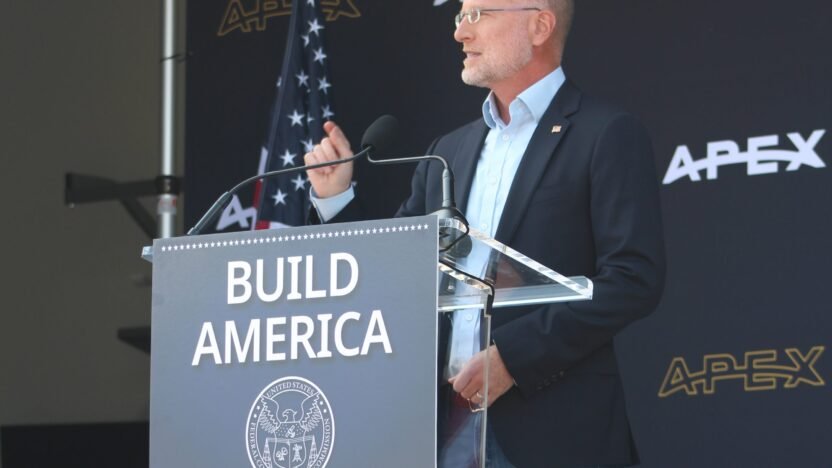
FCC Chairman Brendan Carr said the order would boost the U.S. space economy as LEO becomes increasingly strategic for commercial and government satellite systems.
“Getting the regulatory framework right will determine if America wins this Space Race 2.0,” Carr said in a statement.
“That is why the agency started a process last year to fundamentally change how we process satellite and earth station operations. We bring that effort to conclusion with our Space Modernization Order — a decision that will move from bespoke reviews to a consistent, predictable, and objective assembly line process.”
However, if adopted, pending applications for the massive orbital data center constellations proposed so far this year, such as SpaceX’s plans for up to a million satellites to support surging demand for artificial intelligence, would not be subject to the order’s revised processing timelines and procedures.
The order also comes as Congress weighs the Satellite and Telecommunications Streamlining Act, which would impose deadlines and other reforms on the FCC’s satellite licensing process.
Another C-band spectrum auction
The FCC is also due to vote July 22 on rules that would enable the regulator to auction off 160 megahertz (MHz) of upper C-band spectrum next year in the 3.98-4.14 gigahertz band.
The spectrum, which sits close to frequencies aircraft radio altimeters rely on, is mainly used by Luxembourg-based multi-orbit operator SES to distribute TV services in the United States.
It would be the FCC’s first auction of new commercial spectrum in five years, Carr said.
“This action will expand access to valuable mid-band spectrum for next-generation wireless services and increase speeds for consumers all while maintaining strong protections for aviation safety,” he said.
“This auction will also raise billions of dollars for the U.S. Treasury. The FCC could only reach this result thanks to the close collaboration with many stakeholders, including the FAA.”
In 2020, the FCC generated more than $80 billion from auctioning 280 MHz of lower C-band spectrum to Verizon, AT&T, T-Mobile and other terrestrial 5G players.
About $13.4 billion of those proceeds went to incumbent spectrum holders, primarily SES and Intelsat, to encourage them to quickly relocate services to the remaining 200 MHz of C-band and to cover relocation costs, including new satellites. SES later acquired Intelsat.
SpaceX hungry for more?
The upper C-band on offer would be more than 35 times larger than the AWS-3 spectrum that was recently re-auctioned on a MHz-POP basis, Raymond James analyst Ric Prentiss noted, referring to a valuation metric that multiplies bandwidth by the population covered.
The sale of AWS-3 frequencies raised about $3.57 billion in total, the FCC announced June 26, with Verizon committing $3.2 billion of that for 82 licenses.
The auction helped settle obligations tied to EchoStar’s failed 2015 AWS-3 bids, years before the company abandoned its terrestrial 5G buildout following an agreement to sell other spectrum holdings to AT&T and SpaceX.
SpaceX, which has spent billions of dollars acquiring EchoStar spectrum to improve its direct-to-smartphone capabilities, won just two AWS-3 licenses for about $9 million after minimal bidding.
One investor theory is that SpaceX did not intend to win any licenses as it was using the process to educate itself on FCC auctions, New Street Research analyst David Barden said.
Others believe SpaceX was only seeking a license to test mobile services in a dense urban environment, Barden said, or was just using the AWS-3 sale as a trial run for the upper C-band auction.
SpaceX could instead be looking to snap up a mobile or cable operator to accelerate its wireless ambitions, though Barden argued an acquisition would be a longer and more expensive path than partnering with a telco.
“Despite their current assertion of U.S. terrestrial mobile intentions, being last to market in a saturated market with the least amount of spectrum doesn’t seem like a great business opportunity,” he added, pointing to EchoStar’s failed attempt.