
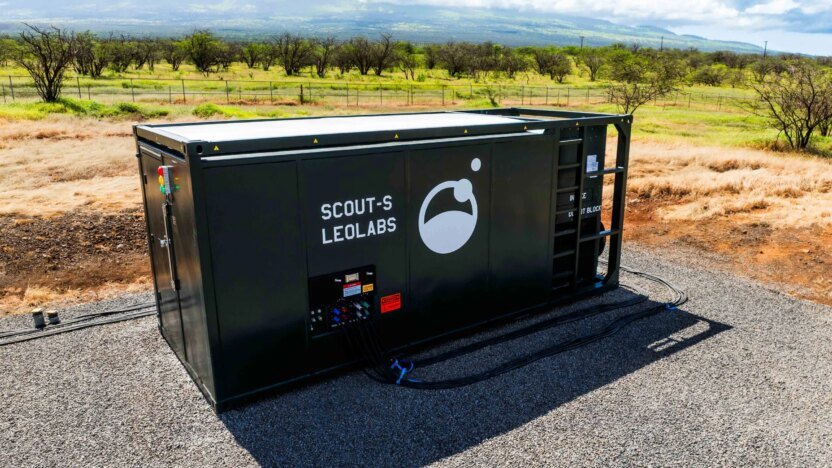
WASHINGTON — LeoLabs said June 10 it has deployed a mobile space-tracking radar in the Indo-Pacific region that is being used to monitor Chinese satellites and other spacecraft.
The California-based company said the new system, known as Scout-S, is tracking maneuvering spacecraft in low Earth orbit, including Chinese surveillance satellites and China’s reusable spaceplane. The deployment comes as U.S. defense officials place greater emphasis on maintaining continuous awareness of objects that can maneuver in orbit rather than simply tracking predictable satellite trajectories.
Scout-S is the first operational system in a planned family of transportable sensors that LeoLabs says can be rapidly deployed to locations where military operators need additional coverage. Unlike the company’s existing network of fixed radars, the new system is designed to fit inside a standard 20-foot shipping container and become operational shortly after arrival.
According to LeoLabs, the first Scout-S radar began observing satellites within hours of activation after being deployed. The company said the system has tracked Chinese Yaogan reconnaissance satellites operating between roughly 800 and 1,000 kilometers above Earth as well as China’s spaceplane program.
The deployment highlights a broader shift in military space surveillance requirements. Operators have typically focused on cataloging objects and predicting orbital paths. That approach is becoming less effective as governments field spacecraft capable of changing orbit, conducting proximity operations and performing other maneuvers that can complicate tracking efforts.
Tony Frazier, chief executive of LeoLabs, said growing activity by potential adversaries is challenging the ability of the United States and its allies to maintain awareness in orbit. He said the priority is increasingly the ability to maintain continuous tracking of maneuverable spacecraft rather than periodically updating orbital predictions.
LeoLabs maintains a catalog of more than 26,000 objects in space and provides tracking data to commercial and government customers. The company has increasingly aligned its business with military demand for space-domain awareness capabilities as concerns grow about China’s expanding space activities.
The Scout-S radar is expected to be used during the upcoming Valiant Shield 2026 exercise, a large-scale U.S. Indo-Pacific Command training event conducted with the Japan Self-Defense Forces and other allied partners. The Hawaii-based exercise will provide an opportunity for military operators to evaluate how transportable sensors could augment existing surveillance networks.
The company is also developing additional versions of the Scout platform with support from U.S. Space Force funding and private investment. Those include Scout-X, aimed at missile warning and missile-tracking missions, and Scout-M, intended for maritime surveillance.
A company spokesperson said Scout-S is currently available for procurement by U.S. government and allied customers, and said the company sees a demand for transportable sensing systems as operators seek more resilient ways to maintain awareness of high-interest objects in orbit.