WASHINGTON — NASA announced one of its biggest reorganizations in recent memory May 22, combining mission directorates and reshuffling personnel.
The reorganization, NASA Administrator Jared Isaacman said in a statement, is designed to increase the agency’s efficiency without laying off staff or closing centers.
“We are focusing resources on the most pressing objectives only NASA is capable of undertaking and liberating the workforce from unnecessary bureaucracy and obstacles that impede progress,” he stated.
The biggest changes involve the agency’s mission directorates. NASA is combining its Exploration Systems Development Mission Directorate (ESDMD) and Space Operations Mission Directorate (SOMD), creating the Human Spaceflight Mission Directorate, or HSMD. The merger effectively recreates the Human Exploration and Operations Mission Directorate that NASA had for a decade before it was split into ESDMD and SOMD in 2021.
NASA said Lori Glaze will serve as associate administrator for HSMD. She had been acting associate administrator for ESDMD. Joel Montalbano, who had been acting associate administrator for SOMD since the retirement of Ken Bowersox nearly three months ago, will be a deputy associate administrator at HSMD. Kelvin Manning, who had been acting director of the Kennedy Space Center since the beginning of the month, will also be a deputy associate administrator for HSMD.
The reorganization creates three program manager positions within HSMD. Dana Weigel will be program manager for low Earth orbit, including the International Space Station and Commercial LEO Destinations. Jeremy Parsons will be program manager for Artemis, while Carlos García-Galán will be program manager for the new Moon Base initiative.
NASA is also combining its Space Technology Mission Directorate with its Aeronautics Research Mission Directorate to create the Research and Technology Mission Directorate, or RTMD. It will be led by James Kenyon, who had been director of the Glenn Research Center. Wanda Peters, who had been deputy associate administrator for programs in the Science Mission Directorate, will be deputy associate administrator for RTMD.
Besides combining the two directorates, RTMD also takes over NASA’s Space Communications and Navigation, or SCaN, program, which has been part of SOMD. Kevin Coggins will continue to lead SCaN as part of the new directorate.
Within RTMD will be divisions for aeronautics, led by Laurie Grindle, and advanced research and technology, led by Greg Stover, who had been acting associate administrator for space technology. Bob Pearce, who had been associate administrator for aeronautics, will instead be a senior adviser for strategy in the new directorate. RTMD will also host the new Space Reactor Office leading work on nuclear programs, led on an acting basis by Steve Sinacore.
NASA reshuffled personnel elsewhere in the agency, including naming John Bailey as associate administrator for the Mission Support Directorate and Kathleen Karika as associate administrator for the Office of International and Interagency Relations.
One former NASA official praised the reorganization. “Ultimately, success at NASA is going to depend more on people than technology, and this is the right team to take us to the moon,” said Mike Gold, president of Redwire Space, who previously served as acting associate administrator for international and interagency relations among other roles at NASA.
“I often think engineering is the easy part of what the agency does. There is no rocket equation for managing huge groups of people and international partners, and the administrator’s decision today will launch us toward an incredible future for NASA, the nation and all of humanity,” he added.
Center leadership changes
NASA’s changes extended down to the field centers, in part because of reassignments of center directors to roles at headquarters. Dawn Schaible, who had been deputy director of the Glenn Research Center, takes over as director after Kenyon was named associate administrator for RTMD.
The agency named Brian Hughes as director of the Kennedy Space Center with Manning’s move to HSMD. NASA had named Hughes earlier this month as senior director of launch operations, a new agency role criticized by some in Congress.
NASA also named Jamie Dunn director of the Goddard Space Flight Center, with Cynthia Simmons, who had been acting director since last summer, returning to her role as deputy director. Dunn had been program manager for the Roman Space Telescope at the center.
At a briefing about Roman at Goddard April 21, Isaacman praised Dunn for his leadership of a flagship-class astrophysics mission that is under budget and ahead of schedule. “I expect Jamie’s going to be in big demand across big agency initiatives going forward,” he said.
The changes do not affect the Jet Propulsion Laboratory, a federally funded research and development center run by the California Institute of Technology for NASA. However, NASA separately announced May 22 that it will compete the contract for running the center, which Caltech has done since JPL’s creation in the 1930s through a series of sole-source contracts.
“The decision to compete this contract reflects NASA’s commitment to strong stewardship of taxpayer resources and positions Jet Propulsion Laboratory to continue driving world-changing scientific discovery and technological innovation for decades to come,” Isaacman said in a statement. The current JPL management contract expires at the end of fiscal year 2028.
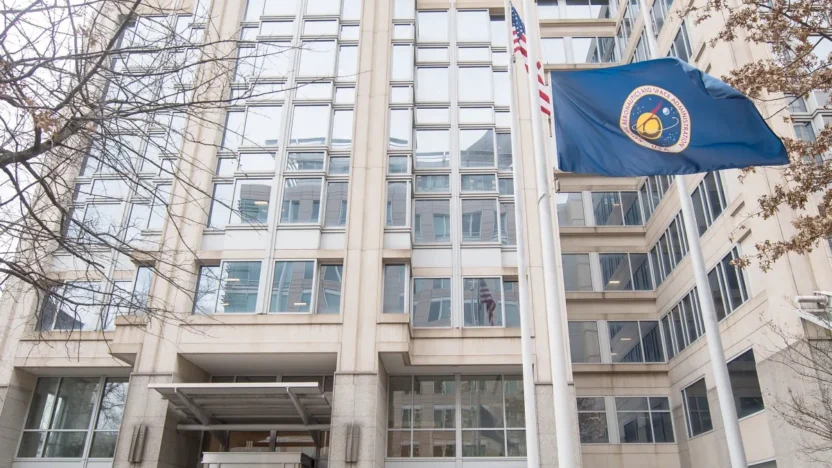
One other element of the announcement that raised eyebrows was the appointment of a “special assignment lead for NASA Headquarters relocation,” a role assigned to Dave Mitchell. The agency discussed last year moving NASA Headquarters out of Washington, with states from Florida to Ohio showing interest in hosting the headquarters.
Those discussions had died down, and at an April 29 event in the Oval Office, Isaacman said that NASA Headquarters would remain in Washington. “I think in terms of the headquarters, we have a lot of people very interested in our mission. So, being here in D.C. gives us the opportunity to interact from all our stakeholders, make sure we make the right decisions for the nation,” he said.
That was endorsed by President Trump. “D.C. is an advantage, I guess, for you,” he said to Isaacman. “Probably staying around is not so bad.”
Isaacman, in a memo to NASA staff, said the new special assignment lead position will look for alternative locations in the Washington area, with the lease on the agency’s headquarters expiring in 2028. “In preparation, we will begin planning for a more efficient footprint while remaining in the D.C. area, ideally freeing up resources to further invest at other centers, like GSFC, that require renovated facilities,” he wrote.