
DENVER — The National Geospatial-Intelligence Agency is expanding its use of artificial intelligence to process growing volumes of geospatial data, even as officials caution that expectations for continuous, real-time insight remain beyond reach.
The rapid adoption of AI-driven analytics has raised expectations that geospatial intelligence can deliver near-constant awareness, compressing the time between data collection and analysis. But that perception is outpacing reality, according to Brett Markham, NGA’s deputy director.
“There are certain people out there who want to know everything about everything all the time, 24/7, 365 days a year,” Markham said May 3 in a keynote speech at the GEOINT Symposium. “In some circles, they think we have that ability today. I wish that were true.”
NGA is a U.S. intelligence agency within the Department of Defense that collects, analyzes and distributes geospatial intelligence — information derived from satellite and other location-based data — to support military operations, national security and disaster response.
AI models now automate large portions of imagery analysis, detecting objects and flagging anomalies at scale. But there are limits in the ability of algorithms to interpret context the way human analysts do.
That gap is influencing how NGA approaches AI investment, Markham said. Rather than treating automation as a solution in itself, the agency is using it to reduce latency and narrow uncertainty for intelligence analysts.
“We’re looking to automate and or apply artificial intelligence to certain workflows that get information from hours down to minutes in the hands of analysts, so that can be quickly turned to decision makers,” said Markham. “The demand signal to know more with precision and timeliness is going to continue to grow,” he said, pointing to rising expectations across military operations in space, air, maritime and land domains.
The shift comes as NGA confronts a surge in data from satellites and other sensors, forcing changes in how intelligence is processed. Analysts are increasingly relying on AI “agents” to identify objects and surface unusual activity, allowing humans to focus on interpretation rather than initial detection.
A key area of development is the use of multimodal AI models. These are systems that combine multiple data types into a single analytic pipeline. In geospatial intelligence, that can include optical satellite imagery, synthetic aperture radar, infrared data and non-imagery sources such as text reports or signals metadata.
The approach is designed to increase analysts’ productivity. Optical imagery can be obscured by weather or darkness, while radar data produces a different representation of the same scene. By integrating inputs, multimodal systems can maintain analytic continuity when one source is degraded.
Much of NGA’s AI work takes place on classified systems, but the agency is increasingly dependent on commercial technology. “We have neither the time nor the expertise to build frontier AI models from scratch,” Markham said, referring to leading-edge systems developed by a small group of companies.
The Pentagon has moved to formalize those ties. On May 1, it announced agreements with several major artificial intelligence firms, including OpenAI, Google, Nvidia, Microsoft and Amazon Web Services, to deploy AI capabilities on classified Defense Department networks.
Within NGA, efforts are also underway to speed up the acceptance of AI tools. The agency has launched a “computer vision model accreditation campaign,” inviting companies to participate in a 90-day process to validate algorithms for national security applications. Firms with accredited models could gain an advantage in competing for government contracts, as those systems are considered vetted for operational use.
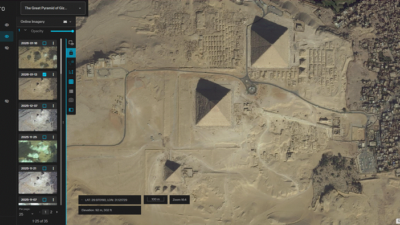
These computer vision models — trained on satellite, aerial and drone imagery — are designed to do more than identify objects. By analyzing imagery tied to specific locations over time, they help analysts infer activity and track changes, forming the backbone of systems such as the military’s Maven Smart System that is now widely used across military and intelligence agencies.