
TAMPA, Fla. — British thermal imaging startup SatVu announced the start of commercial services June 29 for HotSat-2, marking a return to revenue-generating operations after its debut satellite failed in low Earth orbit in 2023.
HotSat-2 is now routinely delivering mid-wave infrared imagery to government and commercial customers following its launch in March, the company said, including for Norwegian defense and aerospace giant Kongsberg’s geospatial intelligence services.
“Many of our original HotSat-1 customers have recommitted to HotSat-2, with further announcements to come,” SatVu CEO and cofounder Anthony Baker told SpaceNews.
“We’ve used the time between the two missions to refine our products and customer service, including improved calibration that lets customers measure thermal change across a timeseries of imagery.”
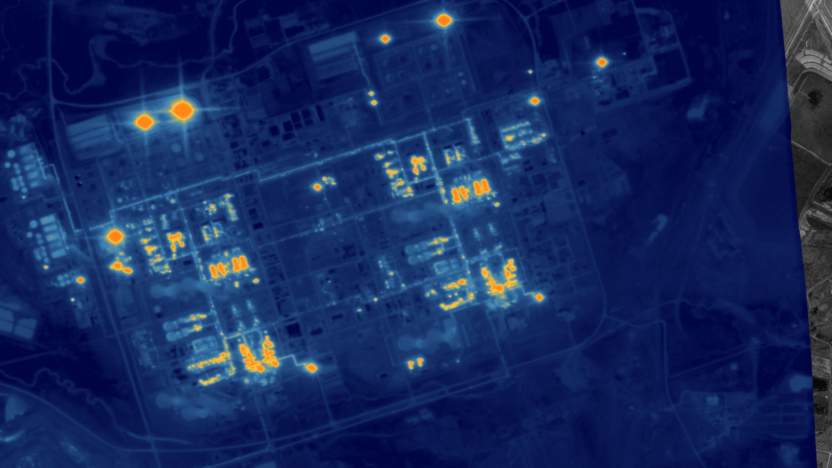
SatVu released first imagery from HotSat-2 in May, using 3.5-meter-resolution thermal data to show reduced operational capacity at the world’s largest refinery in India during disruption in the Strait of Hormuz, along with domestic crude oil refining in Cuba and production at an Australian liquefied natural gas facility.
“Our first-light images demonstrated how high-resolution infrared delivers new and improved insight into thermal activity,” Baker said.
“In the weeks since, we’ve been rehearsing service delivery to meet customer expectations from day one, and improving image quality through careful calibration of the detector.”
He declined to comment on what led HotSat-1 to cease operations just six months into its five-year design life, impacting services for customers that included Japan Space Imaging Corporation, a geospatial information provider.
SatVu earlier said the 160-kilogram HotSat-1 demonstrator, built by Surrey Satellite Technology Ltd. (SSTL), likely suffered a power circuit issue.
“We’re satisfied that extensive efforts were made to investigate the root cause and take corrective action, alongside exhaustive testing of the whole satellite,” Baker said.
SSTL also built HotSat-2 and is constructing another spacecraft, HotSat-3, which he said is being prepared to ship for launch later this year to increase capacity and improve revisit rates.
Construction work has also already started on follow-on spacecraft, Baker added, toward a constellation of 10 or more satellites to meet anticipated demand.