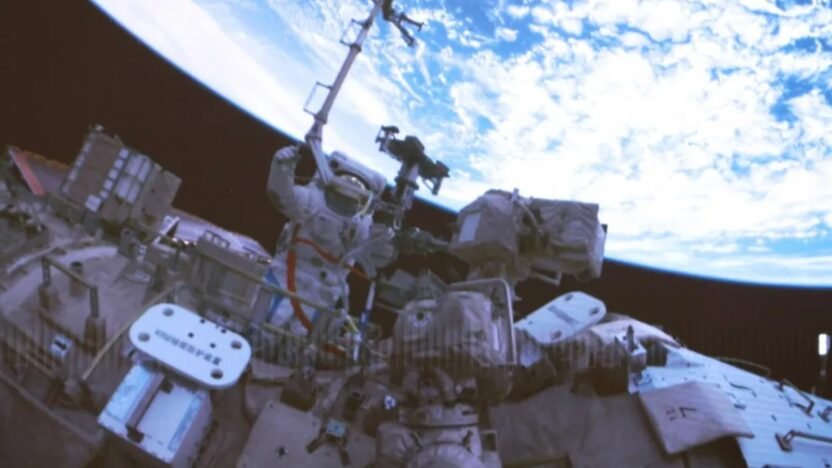
HELSINKI — China’s Shenzhou-21 astronauts conducted an extravehicular activity outside the Tiangong space station Thursday, installing debris-protection hardware and inspecting the orbital outpost.
Shenzhou-21 astronauts Zhang Lu and Wu Fei completed the approximately 5.5-hour spacewalk, or EVA, at 1:36 p.m. Eastern (1736 UTC) April 16 (0136 April 17 Beijing time), returning to the Wentian experiment module’s airlock.
The duo, supported by crewmate Zhang Hongzhang from inside Tiangong, the space station’s robotic arm and ground-based scientific personnel, successfully completed tasks including the installation of debris-protection hardware against micrometeoroids and orbital debris and inspecting external equipment and facilities, the China Manned Space Engineering Office (CMSEO) said in a statement.
Zhang Lu has now carried out a total of seven spacewalks, setting a new record for the number of EVAs performed by a Chinese astronaut. The mission’s previous EVAs took place in December and March, with the former including an inspection of the damaged Shenzhou-20 spacecraft.
CMSEO, China’s human spaceflight agency, formerly issued notice of upcoming spacewalks a day or two before the event. Recent EVAs, including this one, have however only been announced hours after the spacewalk.
The Shenzhou-21 trio have been aboard Tiangong for more than five months, having arrived at Tiangong aboard the Shenzhou-21 spacecraft October 31, 2025. Missions to Tiangong typically last around six months, but CMSEO stated after the EVA that their stay will be extended by one month, making use of the later arrival of the Shenzhou-22 spacecraft.
While the crew arrived aboard Shenzhou-21, they are expected to return to Earth in the Shenzhou-22 spacecraft, likely around mid-to-late May.
Shenzhou-22 was launched to Tiangong on Nov. 25, 2025, following an earlier incident involving debris damage to a viewport on the Shenzhou-20 spacecraft shortly before its planned return. The Shenzhou-20 crew instead returned to Earth aboard Shenzhou-21, requiring a replacement spacecraft to serve as the station’s emergency return vehicle.
The later arrival of Shenzhou-22 effectively resets the available on-orbit lifetime of the crew’s return vehicle, allowing the Shenzhou-21 astronauts to remain aboard Tiangong for longer than a typical six-month mission.
CMSEO said the crew will continue to carry out scientific experiments and technical tests in orbit during the remainder of their mission, and will celebrate China Space Day (April 24) while aboard the station. China marked its first national space day, chosen for the anniversary of China’s first satellite launch, Dongfanghong-1, in 1970. The event will be marked by conferences in the city of Chengdu and outreach events more widely.
Tianwen-2, reusable launcher test flights
In a separate press conference April 17, Liu Yunfeng, deputy director of the China National Space Administration (CNSA), noted that the Tianwen-2 spacecraft is approaching its target asteroid for close-in exploration, without providing specifics. Maneuvers could start in June, with unofficial indications pointing to an early July rendezvous with the near-Earth asteroid Kamo’olewa.
Liu added that the human spaceflight program will carry out the Shenzhou-23 and other crewed spaceflights, while multiple types of reusable rockets will undergo flight tests. The debut flight of the reusable Long March 10B—a cargo variant of the Long March 10A for crewed flights—is expected during a window April 28-30.
There is also expected to be an attempt to recover the first stage at sea using a vessel equipped with a cable recovery system. Also expected are test flights of the Long March 12B, Galactic Energy’s Pallas-1, and Orienspace’s Gravity-2, along with further flights of Landspace’s Zhuque-3, among others.