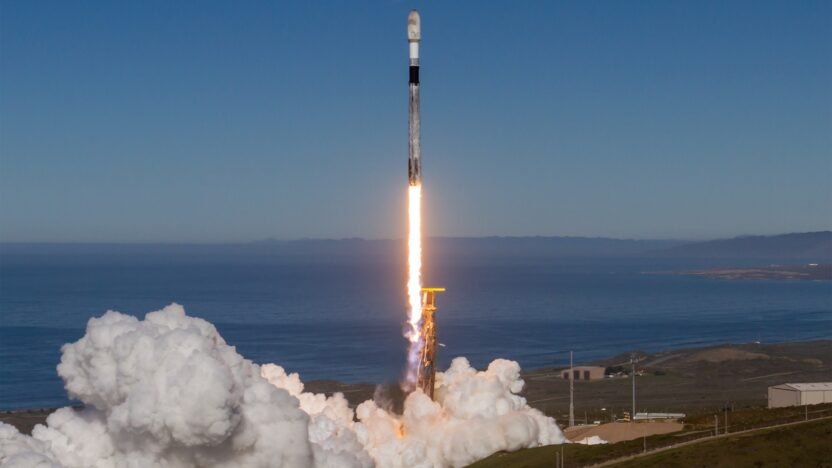
For years, small satellite manufacturers have built their business plans around the idea that SpaceX could launch their payload to space. Through its Falcon 9 Transporter and Bandwagon rideshare missions, SpaceX offered frequent, reliable and inexpensive transportation to sun-synchronous and mid-inclination orbits.
But now worry is setting in.
At least nine SpaceX partners and customers tell SpaceNews that SpaceX is not accepting Transporter reservations beyond late 2028 or early 2029, and the manifest for the next couple of years is nearly full. Some customers said they expect that SpaceX will extend Falcon 9 rideshares if its super heavy-lift Starship rocket does not come online as quickly as company leaders anticipate.
But the lack of spots — potentially as few as half as many as in recent years — has left satellite companies scrambling to find a way to space.
SpaceX did not respond to questions about the future of its rideshare flights.
“We’ve arrived at a point where launch has not achieved the cost nor the frequency the broader sector anticipated and has become a significant and dangerous bottleneck,” space consultant and angel investor Keith Masback said by email.
While secondary payloads can fly with many launch providers, none offer transportation as frequently or inexpensively as SpaceX rideshares, creating uncertainty at a time when manufacturers are producing satellites at a rate faster than launch capability is becoming available.
“There is now a huge demand for access to space and maybe not that much supply,” Valentin Benoit, chief executive for French launch integrator RIDE! Space, said in an interview. “There is a clear asymmetry between the timeline for which satellites need to be launched and what the market can provide. That could be lethal at some point.”
In late May, U.S. launch integrator SEOPS announced the purchase of a SpaceX Falcon 9 rocket to send small satellites to low Earth orbit in a 2028 rideshare. Three weeks later, the manifest for SEOPS’ Waymaker mission was full and approximately 30 customers were on a waitlist.
Executives warn a shortage of launch capabilities could have a series of trickle down effects throughout the industry. This could jeopardizing the future of startups, many of whom assume they will be able to choose among multiple annual rideshare flights and pay about $8,000 per kilogram.
It’s not time for panic, though, SEOPS President Evan Hoyt said in an interview. Instead, satellite operators need to consider launch along with other long-lead items about 36 months ahead of need — rather than 12 — and commit the capital necessary to book flights early.
Prices will rise
For all the uncertainty in the launch market, industry executives agree on one trickle-down effect: The price of launching small satellites is rising. Satellite operators who assume future launch costs will mirror those of SpaceX rideshares face an unpleasant surprise.
“Considering the current state of the art of the launch providers, we should all expect more [of] a price increase than a price decrease,” Benoit said. “The shortage of capacity is making the market understand better that they cannot expect the same level of prices. And it’s better to launch at twice the rate, than not to launch at all.”
Satellite operators are getting the message.
“Our customers are increasingly optimizing for factors other than price, such as orbit control, launch timing certainty, or execution risk,” Robert Sproles, chief executive of the German launch integrator Exolaunch, said by email. “Those factors become more important as constellation operators mature and scale. Therefore, we see a general trend toward accepting higher launch costs in order to support these priorities.”
Reductions in annual rideshare flights also offer opportunities for global launch providers.
“We all need to jump on the opportunity” by increasing launch cadence and managing costs, Xavier Lancel, head of marketing and business intelligence for Vega and Vega C prime contractor Avio, said in May at the SmallSat Europe conference in Amsterdam.
Into the breach
Given growing demand, companies worldwide are working to expand their supply and offer more options for getting to orbit.
Since the manifest of Europe’s Ariane 6 is fully booked for 2026 and 2027 and few slots remain for 2028, European launch provider Arianespace is preparing to offer additional capacity in 2029 and 2030. Ariane 6 is being equipped with a Multi-Launch System that will allow the rocket to send secondary payloads to multiple orbits, Arianespace Vice President Aaron Lewis said by email.
In addition, Exolaunch has purchased two Falcon 9 launches for rideshares in late 2027 or 2028. And RIDE! purchased space for 1,000 kilograms on the 2028 SEOPS Waymaker mission for European customers.
“What we need to do is generate as much launch capacity as the market’s looking for. And they’re looking for a lot,” Hoyt said.
Even with the Exolaunch and SEOPS flights, there are likely to be three to five rideshare missions per year, compared with six to eight in the recent past. To make up the difference, other launch providers would need to supply “at least the equivalent” of three to five rockets offering six to eight tons of launch capacity per year, Benoit said.
Fewer rideshares is good news for a group of small launch vehicle developers striving to reach orbit for the first time. The pack includes Germany’s Rocket Factory Augsburg, ISAR Aerospace and HyImpulse, PLD Space of Spain, France’s Maiaspace, India’s Skyroot Aerospace, Australia’s Gilmour Space Technologies, the United Kingdom’s Skyrora and China’s Galactic Energy and iSpace. Still, it will take time to see which of the new rockets provide reliable, cost-effective flights.
Plus, many early flights of the new rockets have already been claimed by commercial, civil and military customers.
Surging military spending in Germany and other nations will further fuel launch demand and “increase the scarcity of this resource,” Josef Wiedemann, Isar Aerospace sales director, said at SmallSat Europe.
“If you want to launch all the things that we have in mind by 2028, 2029 and 2030, it’s time now to industrialize,” Wiedemann said. “I cannot magically make rockets appear in one or two years. You need machines; you need people. To really scale, you need to further accelerate the execution.”
Also complicating the launch picture is a dearth of available medium and large rockets. Anomalies had already sidelined the United Launch Alliance Vulcan Centaur rocket and India’s Polar Satellite Launch Vehicle before Blue Origin’s New Glenn rocket exploded May 28 during hotfire testing at Cape Canaveral, Florida. While Vulcan and New Glenn were not expected to provide extensive rideshare opportunities, they could loft some small satellites alongside primary payloads. PSLV has a track record of offering rideshare but its current manifest centers on Indian government missions.
“For any launch provider, it’s always the same set of priority: defense clients, institutional clients, megaconstellation or legacy commercial companies and then smallsat,” Benoit said. “We thought that the launch market was supposed to balance the current rideshare program discontinuity, but obviously they are not mature enough or they are not as reliable as expected.”
Starship to the rescue?
One mystery looming over the market is Starship. While companies are banking on Starship providing plentiful space access, SpaceX’s near-term priorities for the super heavy-lift rocket are deploying upgraded Starlink communications satellites and providing lunar transportation for NASA’s Artemis 3 Human Landing System. Martian missions, point-to-point terrestrial delivery and orbital data centers were other Starship priorities cited in the SpaceX S-1 registration statement filed with the U.S. Securities and Exchange Commission ahead of the June 11 initial public offering.
“Once Starship flies, I fully expect that they are not going to offer that up for commercial use for at least a couple of years,” said Chris Quilty, Quilty Space co-CEO and president. “Any company banking on Starship as the solution to their problem better be ready to wait until the 2030 timeframe to get access to that launch vehicle.”
Space access is a familiar problem for space industry veterans.
“When I first came into this industry back in the mid-2000s, the number one challenge for the industry was that launch was extremely rare and very expensive,” Quilty said. “Irony of all ironies, last year, we had 179 launches here in the U.S., and I would tell you that the exact same concern exists. The number one constraint on this industry’s growth is launch.”
For small satellite builders, SpaceX began simplifying space access with Transporter’s first flight in 2021 and Bandwagon’s in 2024.
“All of a sudden, the spigot got opened on launch,” Hoyt said. “It became easy and cheap.”
The abundant flights helped companies test technology and begin establishing the constellations that filled Transporter and Bandwagon manifests.
“Rideshare programs are great at providing regular and reliable access to space for a heterogeneous manifest, but when a customer requires multiple satellites on a single launch, the rideshare manifest becomes quickly saturated,” Sproles said.
If SpaceX intended the rideshares to squash emerging competition from Firefly Aerospace, Rocket Lab and others, the effort failed, Quilty said. However, SpaceX did establish a rideshare capability “that the industry is incredibly dependent upon.”
The SpaceX S-1 published before its initial public offering made clear the company is focused on its transition to Starship, but that Falcon 9 and Falcon Heavy will provide transportation for NASA crew rotation and national security payloads.
If Falcon 9 and Falcon Heavy fly at a diminished rate while Starship begins operations, “hopefully that provides enough of a transition path where these newer small to medium launch vehicles can backfill the demand,” Quilty said.