To some, space is the final frontier. But the reality is that once you leave Earth’s atmosphere, you’re not entering a single, uniform void. There are several frontiers up there — distinct orbital zones — and each throws a very different set of problems at us. What works perfectly in one orbit might fail completely in another.
As the space industry accelerates toward a fast-growing multi-orbit economy in 2026, we’re bringing our low Earth orbit (LEO) habits with us. LEO hardware is fantastic for what it does. It’s characterized by high-volume manufacturing and cost-effective components, including limited radiation shielding.
But dragging LEO technology into medium Earth orbit (MEO), a harsher zone sitting between 2,000 and 36,000 kilometers above us, is creating a massive MEO durability crisis. MEO demands another level of environmental protection and adaptation that standard commercial-off-the-shelf electronics and other components simply aren’t capable of.
While the vulnerability of these electronics is well-documented, it’s really just the blinking “check engine” light of a much deeper, systemic issue. Beneath the avionics and shiny solar arrays lies a massive, under-discussed materials science crisis. We are essentially trying to build a more permanent orbital infrastructure using materials designed for short-term use. If we don’t radically rethink our approach to material durability — specifically regarding the structural composites that form the backbone of modern orbital vehicles — our grand cislunar architecture will physically degrade before it can mature.
The “Stay and Serve” paradigm
Historically, our operational footprint beyond LEO has been defined by short-term “launch and burn” missions. Upper stages, kick motors and transfer vehicles do their job, fire their thrusters and then either retire to graveyard orbits or burn up on reentry. But the emerging orbital economy isn’t short-term use, and that presents a very different set of challenges.
The next decade will be defined by Orbital Transfer Vehicles (OTVs), orbital gas stations and bustling satellite servicing hubs. These satellites aren’t transient tourists. They are expected to operate in MEO and geosynchronous equatorial orbit (GEO) for years, repeatedly docking with client satellites, pumping potentially volatile cryogenic propellants and maneuvering assets into new positions.
This operational shift introduces a whole new world of mechanical stress. Standard LEO hardware simply doesn’t have the structural stamina for a multi-year “stay and serve” lifestyle. Imagine the continuous, cyclic loading of repeated docking operations, mixed with the wild temperature swings of MEO. Every time a servicing vehicle catches a client satellite, a physical shockwave ripples through the chassis and those highly pressurized fuel tanks. Over years of service, these constant bumps and bruises risk pushing standard structural materials well past their fatigue thresholds.
While commercial operators rarely publicize hardware failures, NASA provided proof that LEO baselines will fail in MEO.
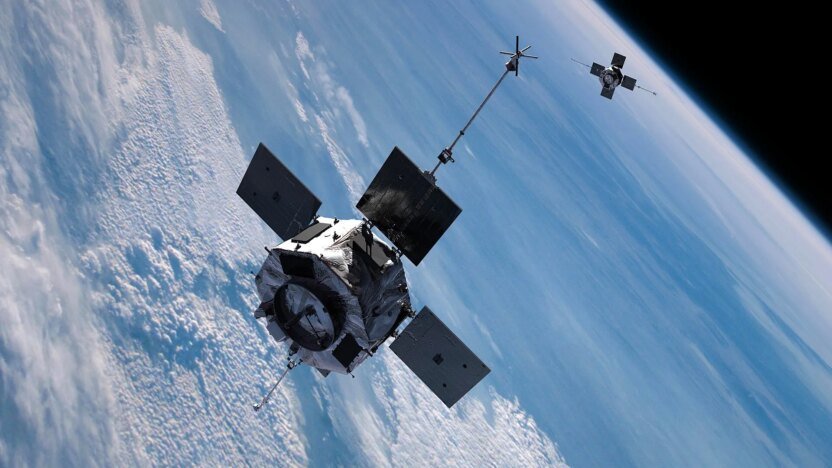
When designing the Van Allen Probes, engineers found that standard, high-heritage LEO design practices were insufficient. To survive the harsh radiation belts, NASA had to abandon commercial-off-the-shelf components in favor of a heavily customized architecture featuring extensive structural shielding, radiation-hardened electronics and specialized fault-management software. Plus, the probes were built for a seven-year mission. Today’s commercial MEO assets are being tasked with 15-year lifespans. Expecting LEO hardware to double the lifespan of specialized MEO satellites isn’t just optimistic — it’s a multi-billion-dollar gamble against physics.
The unsung hero under siege
To truly understand this durability crisis, we have to zoom in on the unsung hero of spacecraft structures and pressure vessels: the epoxy resin.
Modern spaceflight loves carbon fiber composites, and for good reason — they offer incredible strength and durability without the heavy payload penalty. In a composite pressure vessel, the carbon fibers are the muscle, providing crucial tensile strength. But it’s the intricate chemical lattice of the epoxy resin that acts as the glue, holding the entire matrix together.
That is, until they reach MEO and face the punishing environment of the higher-energy Outer Van Allen radiation belts. Here, spacecraft are subjected to intense ionizing radiation, prolonged exposure to the vacuum of space, and extreme thermal cycling.
This environment attacks the material on two distinct fronts:
- Radiation Damage: High-energy radiation can degrade the mechanical properties of specific carbon fiber materials and break down the essential polymeric bonds within the resin systems.
- Outgassing: Under vacuum conditions and intense thermal cycling, standard resins suffer from outgassing, releasing volatile organic compounds and moisture that can migrate away from the material.
This is a double-barrelled threat to the commercial space economy:
Severe operational issues: First, those evaporated compounds don’t just disappear; they adhere to cold surfaces. They condense on sensitive optics, star trackers and camera lenses — not just on servicing vehicles, but on the multimillion-dollar client satellites they are sent to refuel. These outgassed molecules can also condense on solar panels, which are critical to meeting the mission’s energy requirements.
Shattering the matrix: Second is the effect on the tank itself. As the resin loses its chemical integrity through radiation and outgassing, the structural lattice is left dangerously compromised. The once-resilient polymer matrix turns brittle. Micro-cracks start to creep through the structure, and the very tanks meant to safely store highly pressurised propellants become vulnerable to catastrophic structural failure.
The benefits of pre-preg and the chemical lattice
The reality is that we can’t simply “scale up” LEO manufacturing techniques to conquer MEO and cislunar space. Adding thicker walls to composite tanks to compensate for degradation only cannibalizes payload mass, defeating the very economic purpose of using composites in the first place. Instead, the solution lies in chemistry.
So what are the solutions?
Re-engineering the chemical lattice of our composites to prevent long-term fatigue is fundamental to the growing MEO industry’s efforts to create a safe, commercial reality.
The aerospace sector must prioritize the development and rigorous qualification of novel, radiation-hardened resin systems that resist polymer degradation. We need matrix materials engineered at the molecular level to withstand deep-space outgassing and the cumulative fatigue of repeated docking maneuvers, all without sacrificing the lightweight properties that make orbital logistics economically viable. There is amazing work being done with NASA-backed polybenzoxazines and cyanate esters, but these are often prohibitively expensive and require high-temperature curing processes.
Additionally, adapting our manufacturing approaches can bridge this gap today. For example, transitioning from traditional wet winding to pre-preg composite fibers — where filaments are pre-impregnated with specialized polymers under strictly controlled laboratory conditions — delivers a uniform consistency that wet winding cannot match. This enables a thinner, highly uniform, and stronger overwrap for Composite Overwrapped Pressure Vessels better suited for the rigors of MEO.
The next phase of the “new orbital economy” requires shifting these advanced manufacturing paradigms from expensive, bespoke deep-space probes into high-volume, commercial production.
As an industry, our focus has overwhelmingly been on the software, sensors and launch vehicles required to reach higher orbits. But reaching MEO is only half of the journey; surviving there is the true test. The launch-and-burn materials of the past will not sustain the new orbital economy. It will be built upon atomic-level durability, and it’s time we ensure our hardware is truly ready for the long haul.
Tony Morrin is the director of AMSCC Aerospace, which delivers flight-proven carbon composite gas tanks for satellites and launch vehicles that meet the exacting demands of modern space missions.
SpaceNews is committed to publishing our community’s diverse perspectives. Whether you’re an academic, executive, engineer or even just a concerned citizen of the cosmos, send your arguments and viewpoints to opinion (at) spacenews.com to be considered for publication online or in our next magazine. If you have something to submit, read some of our recent opinion articles and our submission guidelines to get a sense of what we’re looking for. The perspectives shared in these opinion articles are solely those of the authors and do not necessarily represent their employers or professional affiliations.