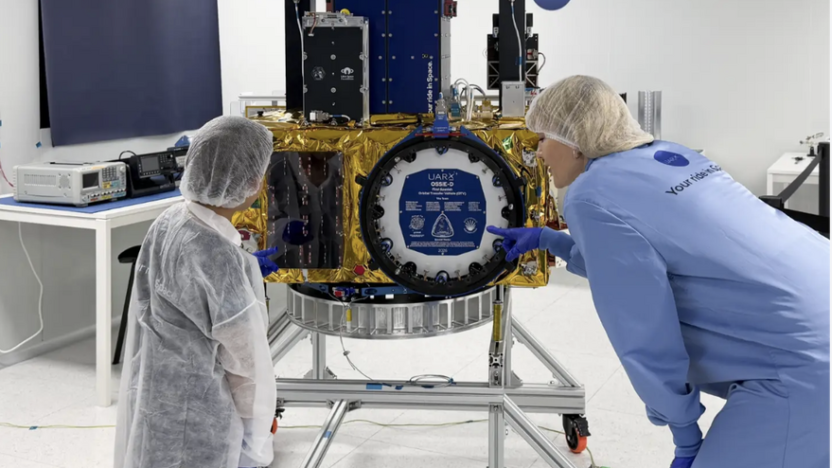
SAN FRANCISCO –Spanish startup UARX Space is remedying anomalies identified during the maiden flight of OSSIE-D, an orbital transfer vehicle (OTV) launched Oct. 1 aboard SpaceX’s Transporter-18 mission. At least 10 PocketQubes have been deployed.
“Immediately after launch, we experienced a communications blackout with our spacecraft,” Andrés Villa Granata, UARX co-founder and chief technology officer, told SpaceNews by email.
To fix the situation, UARX “decided to send a backup command to the OTV to enable” fault detection, isolation and recovery automation “that would deploy the payloads without ground station intervention,” Villa Granata said.
UARX sent the command to deploy payloads two days after launch “but, without reliable two-way communications with the vehicle, we didn’t know if the command was properly received,” Villa Granata said. “We made this decision to prioritize our customers’ missions in case OSSIE had more serious problems” and because we were “aware of the lifetime of the spacecraft operating on batteries.”
UARX now knows that the communications blackout was caused by “a configuration error on the interface of the Ground Station service we are using,” Villa Granata said. “The configuration was corrected, and from that point communication with OSSIE has been nominal. Since then, all spacecraft systems check outs have been performed and everything is performing nominally.”
Since communications have been restored, UARX was “able to wake up the sequencer from its ultra-low-power mode and download our deployment telemetry,” Villa Granata said. “The telemetry shows that our commands sent” two days post-launch “were received correctly. We also obtained telemetry that indicates all commanded deployments were executed correctly and the payloads were released.”
Additional payloads remain onboard OSSIE, short for Orbit Solutions to Simplify Injection and Exploration, a 200-kilogram class OTV. Some are hosted payloads like Dawn Aerospace’s Docking and Fluidic Transfer Port.
Others satellites on OSSIE “will be released in the future, Villa Granata said. “However, we cannot provide specific details about these customers.”
OSSIE customers
Prior to launch OSSIE-D was scheduled to deploy satellites seven and 30 days post-launch.
Some customers have posted news of their missions like German nonprofit AMSAT-Deutschland, which sent three PocketQubes into orbit on OSSIE-D.
“While the successful launch was still being celebrated in Bochum and preparations for the next planned activities were underway, a surprise announcement came in on Saturday evening, October 3,” AMSAT-DL posted Oct. 4. “We would like to inform you that we have decided to initiate the deployment sequence for the OSSIE-D payload earlier than originally planned. The deployment sequence for the deployable payloads began on October 2, 2026, at 1:48:09.950 p.m. CEST.”
Since AMSAT-Deutschland did not expect its satellites to be deployed so soon, “no one had been listening to the transmission frequencies,” the post said. “The signals from the ERMINAZ satellites went unheard at first.”
“Our three ERMINAZ-2 PocketQubes have been successfully deployed from the Picobus Deployer from Libre Space Foundation on OSSIE-D,” AMSAT-DL President Peter Gulzow told SpaceNews. “Two of our Satellites, ERMINAZ-2U and ERMINAZ-2V, are operating and under commissioning. The third one, ERMINAZ-2X status is unknown, as we have not yet been able to acquire a signal from it.”
OSSIE-D also transported PocketQubes built by the Libre Space Foundation, Orion Space of Nepal and Argentina’s National Technological University – Haedo Regional Faculty. Argentia’s National University of La Plata and Ethereal Space sent cubesats aloft on OSSIE-D.
Argentine company DIYSatellite supplied PocketQube dispensers for OSSIE-D and arranged flights for customers.
“From our side, the mission continues according to the planned timeline, and we expect our satellites to be deployed in the next weeks,” Gustavo Carpignano, DIYSatellite CEO said by email. “We will be able to assess and confirm the performance of our deployer once that deployment takes place.”
Ten OSSIE-D PocketQubes had been deployed and contacted by customers as of Oct. 15, Villa Granata said.
UARX co-founders declined to comment on the status of other satellites launched inside OSSIE-D.
Prior to the launch, UARX announced on Instagram that two three-unit cubesats from Ethereal Space were “integrated within RAMI, our CubeSat deployment system, from where they will be deployed into orbit to begin their mission.”
“Spaceflight is inherently challenging, and not every mission milestone unfolds as originally anticipated,” Ethereal CEO Shawn Cochran told SpaceNews by email. “What remains unchanged is Ethereal Space’s commitment to building a reliable, operational space-weather observing capability. We remain confident in our technology, our team, and the long-term importance of providing high-quality space-weather observations to government and commercial customers.”
OSSIE’s maiden flight was also the first demonstration of UARX deployment rings SAU&RON 24 inch and SAU&RON 15 inch.