1
Rocket Lab has delayed its Neutron launch vehicle once again after carbon fibre manufacturing problems on the first stage propellant tank.
Neutron is not the first rocket to encounter difficulties with the material. Most developers build primary structures from steel or aluminium.
Carbon fibre’s most famous property is its extremely high strength-to-mass ratio. A kilogram of the material is stronger than a kilogram of aluminium or steel.
For rockets designed to be partially or fully reusable, or those in the small-lift class, engineers seek every mass saving available. Mass not spent on the primary structure can be allocated to payload. This allows the same rocket, with the same propellant and engines, to launch heavier and larger payloads.
These advantages have been demonstrated on multiple vehicles, most notably Rocket Lab’s Electron. It is the most active vehicle in its class, having flown almost 100 times with a 96 percent success rate. It became the first carbon fibre rocket to reach orbit in 2018. Firefly Aerospace’s Alpha also uses the material. Block 1 has logged seven flights, with an upgraded Block 2 coming soon. Isar Aerospace’s Spectrum has flown only a couple of times but reached orbit on its second attempt. All three are in the small-lift class.
Electron is advertised at 300 kilograms to low Earth orbit, while Alpha and Spectrum are advertised at one tonne. A saved kilogram forms a larger percentage of a 300-kilogram budget than a 20-tonne budget.
Material science is complex, as is the construction of carbon fibre.
Fibre grade refers to the specific type used. This ranges from cheaper lower grades to stronger but more expensive and harder-to-work higher grades. Fibre volume fraction is the proportion of the finished composite that is carbon fibre rather than resin. Higher fractions improve strength and stiffness. Excessively high fractions make the part difficult to manufacture. Excessively low fractions leave too much resin and weaken it.
Layup refers to the orientation of the fibre layers. Carbon fibre is extremely strong along the direction of the fibre but weaker across it. The individual plies are therefore laid in varying orientations to handle the different directional loads a rocket experiences in flight. Those changes in direction can sometimes be seen as the material is being placed.
Fibres can be laid by manual hand-layup or Automated Fiber Placement.
Hand-layup is slow, less consistent, more prone to human error, and poorly suited to high production rates.
Automated Fiber Placement is automated, faster, and more consistent, but requires significant upfront investment in tooling. Carbon fibre can deliver substantial mass savings. However, primary structure that will see the speeds and forces of atmospheric flight must be manufactured to high standards.
Early in the year Rocket Lab tested the first full-size Stage 1 propellant tank. The qualification article was built by a third-party company using manual hand-layup. This was a schedule workaround while Rocket Lab commissioned its own large Automated Fiber Placement machine. The in-house machine had always been the long-term plan for a highly repeatable process. The tank was intended to prove the design and manufacturing approach under pressure.
On the night of 21 January it ruptured during hydrostatic testing, in which the tank is filled with water and pressurized.
Peter Beck attributed the failure to the third-party hand-layup process used on that specific article.
Rocket Lab then switched to its new Automated Fiber Placement machine. The change allowed removal of joints and inserts left by the manual process. It also permitted thicker carbon composite in the forward and aft domes.
After layup the composite is cured in an autoclave. Inspection of the cured forward dome revealed tiny air pockets, known as voids, in the new thicker areas.
Thicker sections are harder to cure cleanly. Heat and pressure must force the resin through the layers and expel the air. Voids can compromise strength, so the thickened domes did not meet Rocket Lab’s standards.
The company investigated how the voids were forming. Beck stated that Rocket Lab was very close to achieving the correct process on the first attempt and that the issue had been replicated in testing. The problem has been identified. The time required to resolve it has pushed the maiden launch to no earlier than 2027. The broader window is intended to avoid repeated adjustments that followed earlier targets.
Rocket Lab next plans to build the forward dome, analyse it for defects, and assemble a new Stage 1 tank. That tank will undergo the same testing as the article that ruptured in January.
Beck has said the first two milestones are expected before the end of the year, with assembly and testing in the first quarter of 2027. Further detail on the Flight 1 launch date is expected only after those steps. Rocket Lab is not the first company to encounter problems building large carbon fibre rocket structures. Neutron, along with Firefly Aerospace and Northrop Grumman’s Eclipse, is part of a small group of vehicles attempting composite medium-lift designs.
SpaceX originally planned to build the vehicle now known as Starship, then called the Big Falcon Rocket, from carbon fibre. The company later selected steel because of cost, repairability, high-temperature performance, and the fact that steel gains strength at cryogenic temperatures.
Temperature resistance is also relevant for re-entry vehicles. A more temperature-tolerant base material can tolerate a lighter heat shield. Mass savings from carbon fibre can be offset by the additional thermal protection required.
VentureStar, the single-stage-to-orbit spaceplane that never flew, experienced carbon fibre problems on the liquid hydrogen tank of its X-33 subscale demonstrator. The tanks used sandwich construction with composite skins and a honeycomb core. In November 1999, one tank failed after cryogenic loading and draining. The investigation identified several interacting issues. These included microcracking in the inner composite skin that allowed liquid hydrogen to seep into the honeycomb core.
Cryopumping drew air and nitrogen into the core as the tank cooled and warmed, where the gases liquefied and created pressure and damage.
Bond strength between the skins and core was poor in places. Manufacturing defects included foreign-object debris such as tape. When the tank warmed after the hydrogen was drained, the outer skin and core separated from the inner skin.
Carbon fibre has been used successfully on small-lift vehicles but remains untested at medium-lift scale or larger. Large satellite constellations for communications or artificial intelligence are increasing demand for higher payload capacity and cadence.
Rocket Lab is working to qualify the largest pressurized structure yet built from carbon composite.
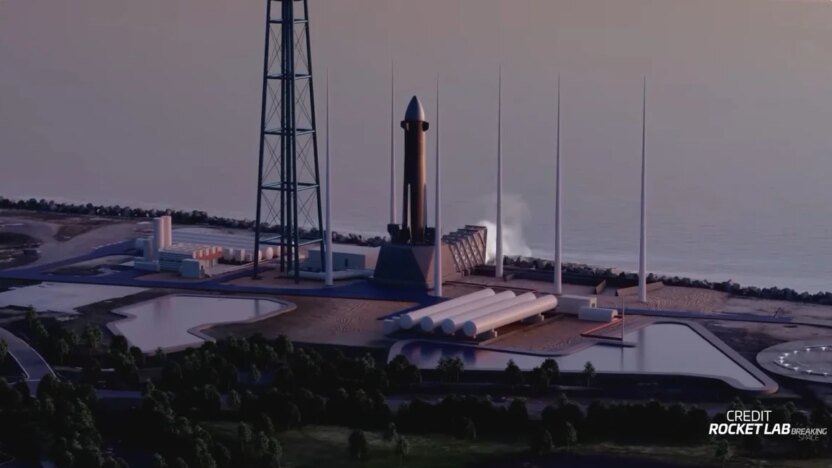
(Featured Image via Rocket Lab)