PADUA, Italy — A spacecraft developed by Tsinghua University is set to join international missions to study the asteroid Apophis during its close approach to Earth in 2029.
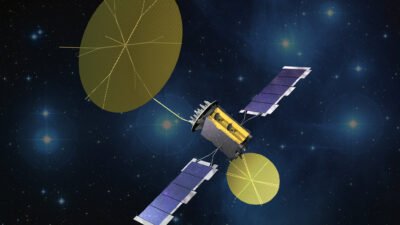
The Student-led Threatening Asteroid Reconnaissance of Tsinghua, or START, mission is a low-cost smallsat led by a team of more than 20 undergraduate students at Tsinghua University in Beijing. It aims to launch in early 2028 in preparation for when Apophis passes within 32,000 kilometers of Earth on April 13, 2029, bringing it closer to Earth than satellites in geostationary orbit.
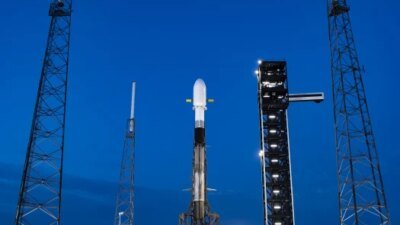
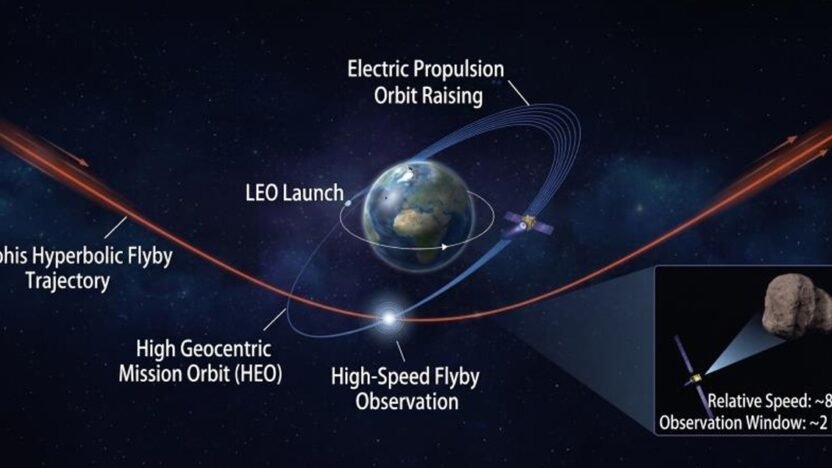
The 200-kilogram class spacecraft will launch on a Zhuque-3 rocket in early 2028 as a rideshare payload provided for free by Landspace, leaving START in a roughly 1,000-kilometer, 55 degrees inclined orbit. From there, the spacecraft will use its Xenon solar electric propulsion system to raise its orbit to 31,600 km over the course of 200 days to prepare for the arrival of Apophis.
“This is a ‘doorstep’ deep space target,” said Bin Cheng, the mission’s chief scientist, presenting remotely from Beijing at the Apophis T-3 workshop here. The approach removes the need for a multi-year interplanetary cruise, he said, cutting both cost and mission complexity.
At closest approach, following a series of trajectory correction maneuvers, START will pass within 7 kilometers of the 340-meter asteroid at a relative velocity of 8.74 kilometers per second. The spacecraft will rely on autonomous tracking to keep its cameras locked on Apophis through the brief encounter, extending what would otherwise be a fleeting observation window.
The payload suite includes narrow and wide-field cameras plus dual visible-to-near-infrared hyperspectral imagers, aimed at achieving a peak resolution of 8 centimeters per pixel, allowing START to resolve individual boulders and track changes to the asteroid’s surface driven by Earth’s tidal forces.
START’s budget is pegged at around $2.8 million, funded through a mix of university support, donations and sponsorship that the team says includes the launch rideshare, electric propulsion hardware and camera components.
Cheng frames START as filling a niche alongside three flagship missions converging on Apophis around the same period. Japan’s DESTINY+ will fly past the asteroid in January 2029 ahead of the encounter, followed by ESA’s RAMSES, a rendezvous mission expected to operate at Apophis from February through August 2029 launching on an H3 rocket with DESTINY+. NASA’s OSIRIS-APEx will rendezvous with the asteroid in April 2029, beginning an 18-month observation campaign. START would be timed to capture the window of peak tidal-stress, delivering data the team says complements the observations from the larger missions.
The project was initiated at Tsinghua in April 2025 and has completed spacecraft system design and is moving into subsystem integration, with prototype development scheduled to begin in September 2026 ahead of a planned spacecraft delivery in September 2027.
An extended mission would see START visit further near-Earth asteroids to provide additional science, and raise its orbit to test the limits of a low-cost solar electric propulsion mission.
Chinese scientists had earlier proposed mission concepts to study Apophis—the close approach of which offers a rare and unique planetary science and planetary defense opportunities—including a cubesat swarm mission and the CROWN/Apophis mission.
China has a growing interest in asteroid missions and planetary defense. The country is planning an asteroid deflection test around 2027, including separate impactor and observer spacecraft, while its Tianwen-2 spacecraft is currently on approach to near Earth object Kamo’oalewa and expected to arrive at the asteroid in early July.