WASHINGTON — As the Pentagon races to build more resilient satellite constellations and other space capabilities to defend against threats from China and Russia, key questions remain unanswered about where competition in space ends and conflict begins, according to a new report from the Mitchell Institute for Aerospace Studies.
The report, based on a January workshop involving more than 50 experts from the military, government, industry, allied nations and academia, concludes that space is no longer a peaceful domain and that adversaries are using increasingly aggressive actions below the threshold of armed conflict to shape the strategic environment while avoiding a decisive U.S. response.
“Conflict in space is more complex than many participants anticipated, hindering efforts to interpret actions, assess escalation, and select appropriate responses,” the report states. “Participants consistently found that the challenge is a combination of a lack of policy clarity and the fundamental nature of the domain itself.”
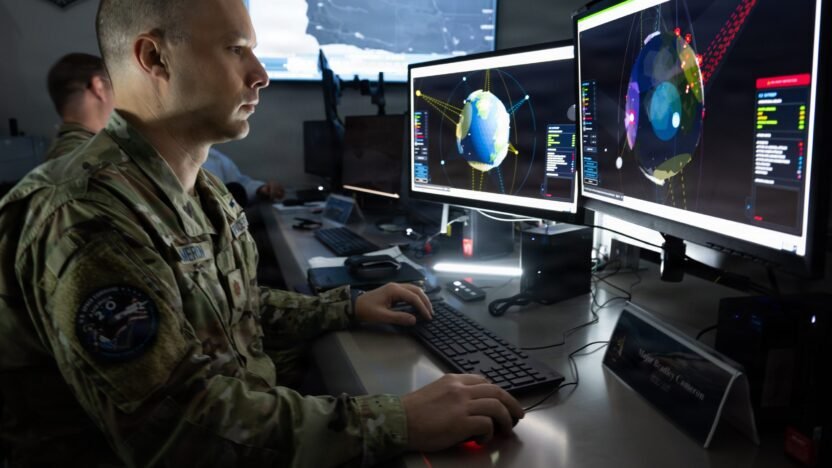
The findings come as the U.S. Space Force seeks to transform itself from a service largely focused on operating satellite systems into one preparing for potential conflict in orbit. Pentagon officials have warned that China and Russia are fielding capabilities designed to disrupt, disable or destroy U.S. space assets that underpin military operations around the world.
Charles Galbreath, a Mitchell Institute senior fellow and one of the report’s authors, said participants concluded that the United States is already engaged in a sustained gray-zone competition with China in space and must prepare for conflict beyond simply protecting its satellite networks.
The report argues that Washington needs a broader range of military response options, clearer rules for responding to hostile actions in space and greater investment in capabilities designed to achieve what military planners call “space superiority” — the ability to operate freely in space while limiting an adversary’s ability to do the same.
Galbreath said workshop participants found that a lack of established norms, legal frameworks and historical precedent has made it difficult to determine when competition in space becomes conflict. Activities such as jamming, cyberattacks, directed-energy interference and close-proximity satellite operations often fall into a gray area that complicates attribution and decision-making.
Adversaries exploiting ambiguity
China is normalizing hostile behavior through jamming, cyber operations, directed-energy attacks and other gray-zone activities while the United States struggles to respond, he said. Over time, the absence of consequences risks allowing competitors to reshape what is considered acceptable behavior in orbit.
The workshop participants themselves could not agree on where competition ends and conflict begins, Galbreath said. The report concludes that there is no widely accepted framework for defining hostile acts in space, making escalation management difficult.
Without clearer policies and credible response options, the report warns, Washington risks allowing competitors to dictate the pace of escalation.
To explore those questions, the workshop examined a series of hypothetical scenarios involving Chinese anti-satellite attacks, Russian interference with satellite navigation systems, Iranian attacks enabled by space capabilities and an unattributed nuclear detonation in low-Earth orbit that disabled hundreds of satellites. The scenarios were designed to test how the United States and its allies might respond to increasingly severe threats across the spectrum of conflict.
The report recommends continued investment in systems designed to disrupt or disable adversary space capabilities while also placing greater emphasis on resilience, rapid reconstitution of satellite networks and protection of commercial infrastructure that increasingly supports military operations.
It also calls for expanded cooperation with allies, stronger cyber defenses for critical space infrastructure, improved public communication about threats in orbit and increased training and exercises focused on space warfare.
The findings arrive as the Space Force appears poised for a major funding increase. The Pentagon’s proposed fiscal 2027 budget would increase Space Force funding from roughly $31 billion in 2026 to $71 billion in 2027.
But Galbreath cautioned that a budget increase alone would not resolve the gaps identified in the report.
“What we’re seeing in the next president’s budget is a good step in the right direction, but I don’t believe that that will be the desired end state,” he said.
“There needs to be a continuous trajectory of increasing our capability and our capacity and the size of the Space Force to handle a wide range of potential threat vectors,” Galbreath added.
He argued that China has spent decades developing capabilities intended to counter U.S. advantages in space.
“China has been thinking about countering our ability to deliver effects from space since the 1990s,” he said. “They’ve been investing in weapon systems from direct ascent to jammers and cyber attacks, co-orbital systems for a lot longer than the United States has been recognizing that space is a war fighting domain.”
The workshop participants agreed that funding “can’t just be in one time infusion, it needs to be consistent and on a growth trajectory.”
He said military success in space will likely depend on the United States’ ability to establish credible deterrence in orbit before conflict spreads to other domains, a challenge that remains complicated by the lack of agreement over what conflict in space would actually look like.