
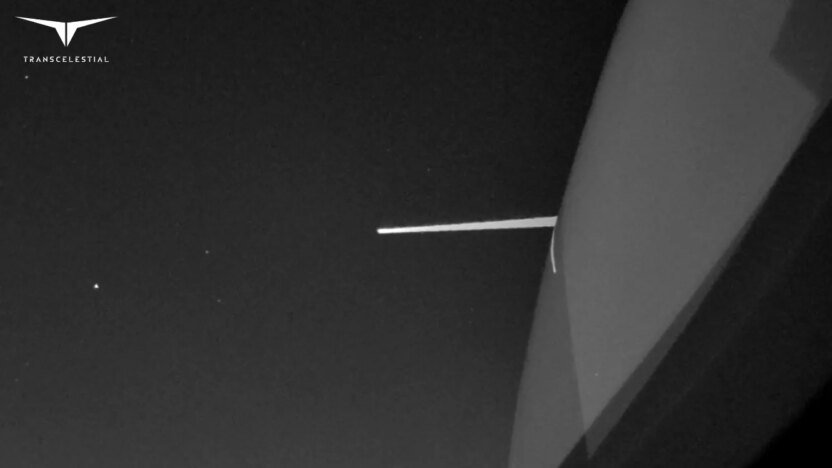
WASHINGTON — Transcelestial has advanced its work to provide space-to-ground optical communications with a test of laser transmissions from a satellite to ground stations.
The Singapore-based company announced May 12 it performed a test where ground stations in Singapore and Spain were able to detect and track laser transmissions from a satellite built by Open Cosmos and launched last year.
The test is a final step before attempting to transmit data from the satellite to those optical ground stations, said Rohit Jha, co-founder and chief executive of Transcelestial, in an interview.
“This is one of the hard parts of putting laser comms into space: how do you quickly acquire both sides,” he said. That is a challenge because of factors like clouds that can interrupt laser transmissions as well as light pollution in urban areas that can make it hard to identify the laser transmission from the satellite.
Jha said his company uses techniques like optical filters on the ground stations’ telescopes to limit light to the frequencies the lasers are transmitting at, as well as unique blinking patterns to distinguish the laser from other sources in the sky.
“Once it’s locked on both sides, are able to use closed-loop tracking to actually track the whole thing across the sky,” he said, with computer vision algorithms that identify the laser and keep it locked in place.
With the ability to identify and track the laser transmissions now demonstrated, he said the company will move into its next phase, testing the system to show it can transmit data to the ground at high rates. Transcelestial is also working to set up new optical ground stations near Austin, Texas, and in Australia.
Transcelestial started with developing terrestrial optical communications systems but is now moving into space-based systems. It has been selling terminals to several satellite manufacturers that can be used for intersatellite links, the most common application of optical communications in space, but also for space-to-ground links. Transcelestial is also planning a data-relay satellite constellation using optical communications.
The company announced May 6 an agreement with Antaris to demonstrate how optical communications could be used for an intelligence, surveillance and reconnaissance constellation Antaris is developing. That includes testing optical communications on the Janus-2 technology demonstration satellite Antaris plans to launch in the fourth quarter.
Jha said Transcelestial has signed up five satellite developers in as many months for its terminals, such as Australian company Gilmour Space. The demand for optical communications terminals for satellites is outstripping supply, he said, with concerns about future availability with the acquisition of Skyloom by IonQ and Mynaric by Rocket Lab.
“I think that creates an opportunity for us because our terminals are one-fourth the size of these other terminals” and also cost less, he said.
That creates a customer base for space-to-ground optical communications, he added, noting there was an uptick in interest in the technology during the Artemis 2 mission. On the flight, NASA successfully tested optical communications to return imagery and video from the Orion spacecraft at much higher data rates than traditional radio-frequency links using the Deep Space Network.
That interest was in evidence, he said, at a recent event he attended where government officials expressed strong interest in optical communications. “If you don’t have laser comm capabilities, whether intersatellite or space-to-ground, in your bus, then you’re far behind everyone else, because every customer with the government or telcos is looking at it and asking for it,” he said.