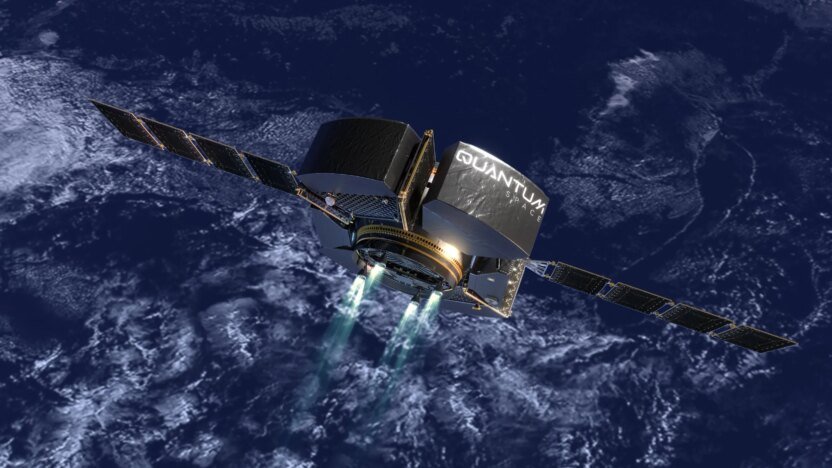
WASHINGTON — Quantum Space announced May 12 it will build the company’s highly maneuverable spacecraft in Tulsa, Oklahoma, home to the company’s new chief executive.
Quantum Space said it would establish a production line for its Ranger series of spacecraft in Tulsa, occupying 25,000 to 40,000 square feet in a building being renovated for the company, with initial operations set to begin there in the first quarter of 2027. The company will first set up in an interim building this year while renovations are in progress.
The announcement comes a week after Quantum Space announced it hired Jim Bridenstine, former administrator of NASA, as its new chief executive. Bridenstine lives in Tulsa and represented a district that included the city in Congress before being confirmed as NASA administrator in 2018.
The company played up Oklahoma’s aerospace industry, rather than Bridenstine’s local ties, in selecting the city as a site for its spacecraft manufacturing facility. “With its new and existing infrastructure, deep aerospace heritage and skilled workforce, expanding our manufacturing to Oklahoma was an obvious choice,” Bridenstine said in a statement announcing the facility.
Quantum Space noted that the aerospace workforce in Tulsa has experience with precision manufacturing and machining technologies that will be applicable to its spacecraft production needs. The company expects to initially create 50 “high-skill” jobs there, increasing as spacecraft production scales.
The Tulsa spacecraft production facility will be in addition to Quantum Space’s headquarters in Rockville, Maryland, which hosts engineering and mission development teams. The company also has a facility in Hawthorne, California, for propulsion integration and testing, which it acquired last year along with multimode propulsion technology from Phase Four.
“Tulsa gives us the workforce, infrastructure and aerospace heritage to build at scale, complementing our propulsion integration and testing in Hawthorne and our engineering base in Rockville, as we accelerate production to meet a broader shift in space operations where maneuverability is becoming a foundational capability across a complex, multi-orbital domain,” said Kam Ghaffarian, executive chairman of Quantum Space, in a statement.
Quantum Space, founded by Ghaffarian originally to pursue cislunar missions, has focused increasingly on national security applications of Ranger, which is designed to have several kilometers per second of delta-v, or change in velocity. The company is one of 14 selected by the Space Force for Andromeda, a multibillion-dollar program to develop satellites and supporting technologies for monitoring activities in geosynchronous orbit.
“Think about avoiding operational surprise, denying first-mover advantage and responsible counterspace campaigning,” Bridenstine said in an interview when he joined Quantum Space. “All of those capabilities require tremendous amounts of delta-v.”
Quantum Space is not alone among space companies in setting up operations in Tulsa. Agile Space Industries, a Colorado-based spacecraft propulsion developer, broke ground in January on the Space Test Center in the city. An initial phase of the center, costing $20 million and using eight hectares of land at Tulsa International Airport, will provide high-throughput test facilities for small and medium-sized rocket engines.