
WASHINGTON — The House Armed Services Committee moved to preserve a Space Force missile-warning satellite program the Pentagon plans to cancel, authorizing $415 million for the Next-Generation Overhead Persistent Infrared Polar program in the markup of the fiscal 2027 defense policy bill.
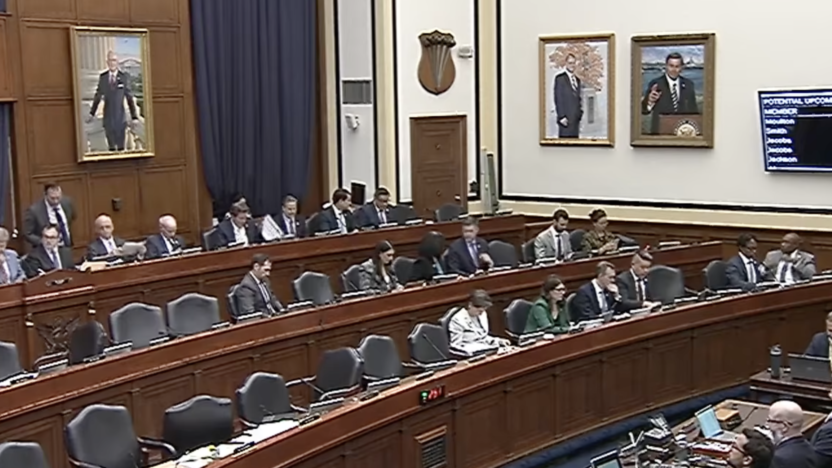
During a markup session June 4, committee members debated amendments to the National Defense Authorization Act.
Among the space-related provisions approved was to keep alive the Next-Gen OPIR Polar, a Northrop Grumman program that has been under development since 2018. The satellites are designed to operate in highly elliptical orbits and provide missile-warning coverage over the Northern Hemisphere, particularly the polar regions.
The Pentagon’s fiscal 2027 budget proposes terminating the program, arguing that newer missile-warning architectures in low Earth orbit and medium Earth orbit have reduced the need for dedicated polar satellites. The administration’s budget documents show the program’s projected cost at $3.4 billion, including approximately $2.1 billion already spent. The budget includes $436 million in fiscal 2026 largely to complete and close out development activities.
The committee took a different view, authorizing $415 million to continue development of the system.
Rep. Seth Moulton, the top Democrat on the Strategic Forces subcommittee, called Next-Gen OPIR Polar a critical capability that has long been supported by both U.S. Northern Command and U.S. Strategic Command.
Moulton argued that China and Russia have demonstrated capabilities specifically designed to degrade or destroy U.S. space assets and said the committee’s mark addresses areas the administration has not taken seriously enough.
Pushback on PTS-G
The committee also raised questions about the Space Force’s recent procurement contract awards for Protected Tactical SATCOM-Global, or PTS-G, a program intended to provide secure military communications through a proliferated network of satellites.
The Space Force announced May 22 that it awarded a combined $437.6 million to Viasat and Intelsat, now part of SES, for secure X-band and Ka-band communications satellites. The contracts include operation of the spacecraft because PTS-G is structured as a government-owned, contractor-operated constellation.
The committee criticized the decision to procure only two satellites — one from each company — for a program that had been promoted as a proliferated architecture. Pentagon budget documents described plans for a “swarm” of four satellites. While the contract announcement did not specify the number of spacecraft being purchased, committee language confirms the procurement consists of two satellites.
“The Space Force highlighted proliferation and disaggregation as attributes they were prioritizing in the President’s budget request,” the committee wrote.
Lawmakers argued that the original program sought to strengthen the industrial base by encouraging new entrants that could leverage commercial manufacturing capabilities and existing hardware. Procuring only two satellites, the committee said, runs counter to the goal of achieving resilience through larger numbers of lower-cost spacecraft.
The committee directed the Space Force to provide a report detailing how it intends to implement a resilient tactical satellite communications architecture consistent with the original objectives of the PTS-G program. Lawmakers also requested options for accelerating procurement of additional single-band satellites to achieve a more distributed architecture sooner.
More focus on PNT enterprise
The bill also reflects congressional frustration with management of the Pentagon’s positioning, navigation and timing enterprise, the collection of systems and infrastructure centered on GPS.
Moulton said the enterprise remains disjointed and underprioritized despite its importance to military operations.
Strategic Forces subcommittee chairman Scott DesJarlais said the committee’s proposal requires the Defense Department to designate a single official responsible for oversight of the positioning, navigation and timing enterprise.
The provision would replace an existing oversight structure that lawmakers have criticized as ineffective. DesJarlais said the measure also removes what he described as duplicative bureaucracy that has slowed development of new technologies and implementation of a broader positioning, navigation and timing strategy.