HELSINKI — Construction of the Shanghai-led Qianfan constellation continued to accelerate this week with a pair of Long March launches, following on from two recent experimental flights.
China launched Long March 6A and Long March 8 rockets Thursday and Friday respectively, adding 36 satellites to the project led by Shanghai Spacecom Satellite Technology (SSST), or Spacesail.
The Long March 6A lifted off at 7:39 a.m. Eastern (1139 UTC) June 4 from Taiyuan Satellite Launch Center in north China. The rocket climbed into the sky just before sunset, producing “jellyfish” like effects in the upper atmosphere visible downrange. The 11th launch for Qianfan, or Thousand Sails, saw 18 satellites successfully inserted into intended polar orbits, the China Aerospace Science and Technology Corporation confirmed.
Genesat, a satellite manufacturing subsidiary of Spacesail, provided the satellites for the Thursday launch. Deployment of Genesat satellites had stalled previously, following issues with a number of the satellites once in orbit, which failed to raise their orbits. Spacesail says it aims to provide global users with low-latency, high-speed and ultra-reliable satellite broadband internet services.
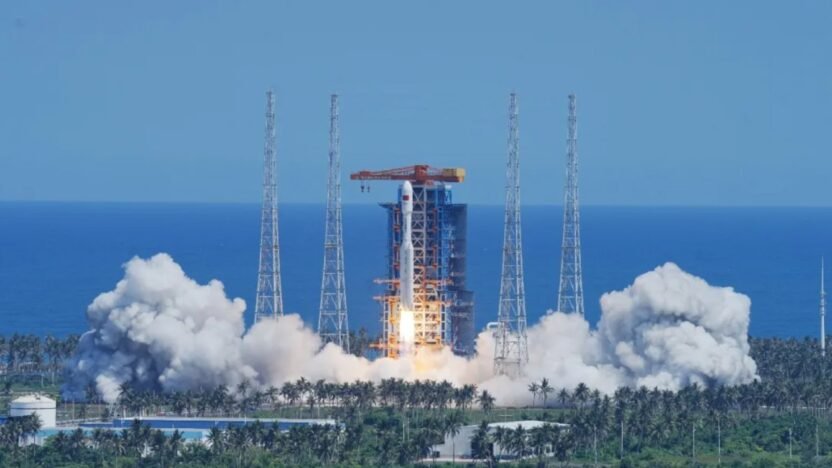
The launch was followed less than a day later by another, this time from the Hainan Commercial Space Launch Site, south China. The Long March 8 lifted at 2:34 a.m. Eastern (0634 UTC) June 5, rising into a blue sky above the coastal spaceport.
The mission delivered another 18 satellites into polar orbits. It was not clear at time of reporting which entity manufactured the satellites, with both Genesat and the Shanghai Engineering Center for Microsatellites (SECM) providing satellite batches for the project. The launches were the 11th and 12th for Qianfan.
Together with a pair of satellites launched on the debut flight of the Long March 12B Monday, Qianfan now has 200 satellites in orbit following Friday’s launch. Qianfan now surpasses the 168 satellites for the national Guowang broadband megaconstellation; a more opaque project likely with national security applications. Both projects aim for more than 10,000 satellites in orbit.
Constellation acceleration
Deployment of the constellation appears to be accelerating. The first launch took place in August 2024, but a pause followed the fifth launch, in March 2025, until the sixth in October 2025. There have now been six launches since April 7.
While launches have relied on CASC’s Long March 6A and, to a lesser extent, the Long March 8—both expendable kerosene-liquid oxygen launchers—developments in recent weeks show a diversification in the pipeline.
Landspace launched an improved Zhuque-2E rocket May 13, carrying a customized payload described as a “large-scale constellation deployment experiment.” The next Zhuque-2E is scheduled to launch June 9 from Jiuquan spaceport’s Dongfeng Commercial Space Innovation Test Area in northwest China. The mid-inclination launch could involve a batch of satellites for a constellation. The larger, reusable Zhuque-3 is expected to have its second launch in the near future also.
More directly, China debuted the Long March 12B June 1, which successfully deployed a pair of Qianfan satellites. The launch did not include a recovery attempt, but features landing legs and a powered descent and vertical landing test is expected in the future. Development of the Long March 12B was completed in 21 months, according to reports, though this does not account for the heritage YF-102R engine program. CASC indicated a follow up mission would come soon.
The launches June 4 and 5 were China’s 37th orbital launches of 2026, as the country targets more than 100 launches in a calendar year for the first time. In addition to the Zhuque-2E launch scheduled June 9, a Long March 5 rocket with an undisclosed payload is set to launch June 10 from Wenchang.