WASHINGTON — The Exploration Company performed a drop test of the Nyx spacecraft it is developing to transport cargo to low Earth orbit ahead of a 2028 test flight.
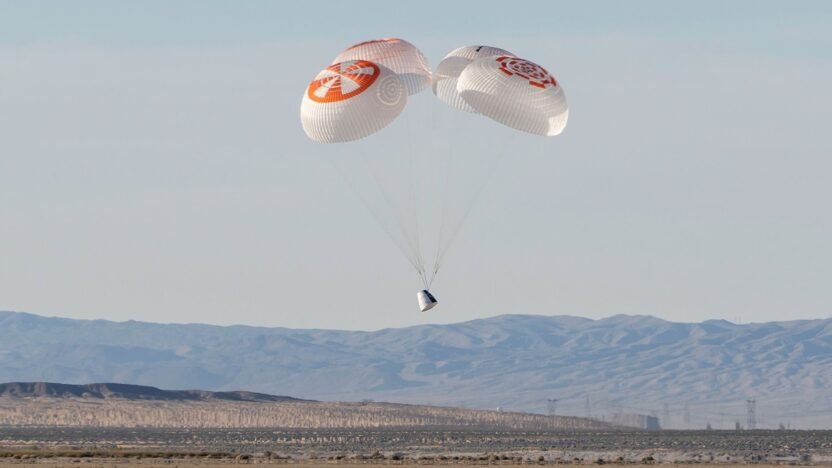
In the May 19 test in California’s Mojave Desert, a helicopter carried a model of the capsule called the Drop Test Vehicle (DTV) to an altitude of 2,800 meters. The helicopter then released the capsule, which first deployed two drogue parachutes to stabilize it. Four main parachutes followed, guiding the capsule to a touchdown on the desert floor.
“Initial analysis confirms that the required conditions and event timings were achieved, including nominal extraction and handover from the drogues to the main parachutes,” the company said in a June 4 statement about the test. “The vehicle dynamics observed during initial release and handover were in line with expectations for this DTV configuration, including its mass and inertia range.”
The company said the test is part of a broader qualification campaign for the parachute system for Nyx. While the capsule is designed to splash down, this test was conducted on land to simplify logistics.
The drop test is part of a broader test campaign for the capsule. In January, The Exploration Company conducted water-impact tests using a scale model of Nyx at an Italian test facility. Those tests were designed to validate models of splashdown conditions.
Parachute deployment and splashdown were two phases of flight the company could not test during its Mission Possible reentry test nearly a year ago. The company flew a capsule on a SpaceX rideshare mission that survived reentry. However, it lost contact with the capsule after reentry and did not recover it after splashdown.
The Exploration Company has not publicly disclosed what went wrong on the Mission Possible flight. A company official said at a conference last October that an investigation was still in progress. A company spokesperson said earlier this year that recent drop tests were not linked to the problems seen on Mission Possible.
The company is planning a 2028 orbital flight test of Nyx that would include a docking with the International Space Station. ESA selected The Exploration Company, along with Thales Alenia Space, for the first phase of a cargo vehicle development program in 2024 modeled on NASA’s commercial cargo services program. The company announced plans for a crewed version of Nyx last June but noted that it was a long-term project.
The Exploration Company’s work extends beyond Nyx. It has been developing engines, including tests of Huracan, a 3,370-pound-force engine using liquid oxygen and methane that it says would be used for future lunar landers and cislunar spacecraft. The company’s website also mentions Storm, a reusable “high-thrust” rocket engine producing up to 400,000 pounds-force of thrust.
“Storm is designed to power a globally competitive launcher,” the company’s website states. The website briefly included such a launcher, called Yrene, but now only mentions “Future Vehicles” without providing details.
Hélène Huby, chief executive of The Exploration Company, said during a visit to the United Arab Emirates in May that the company is seeking to raise $200 million in an upcoming funding round. That funding would support work on the rocket engine project, she told a local publication.