WASHINGTON — Quantum Space, a company led by a former NASA administrator that is developing highly maneuverable spacecraft for national security missions, will go public by merging with a special purpose acquisition company, or SPAC.
Quantum Space announced June 8 that it will merge with Inflection Point Acquisition Corp. VI, a SPAC traded on the Nasdaq exchange. The companies expect the deal to close in the fourth quarter, with Quantum Space then trading on the Nasdaq under the ticker symbol QSPC.
The deal includes a $300 million investment, known as a private investment in public equity, or PIPE, by Inflection Point into Quantum Space. The SPAC also has $253 million in trust that would go to Quantum Space, assuming none of its shareholders redeem their shares. The deal would value Quantum Space at more than $1.1 billion if there are no SPAC redemptions.
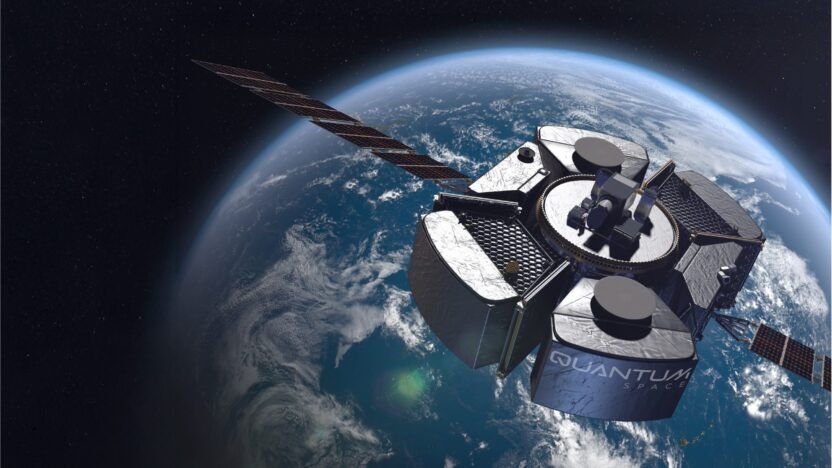
The company plans to use the proceeds to ramp up production of Ranger, a maneuverable spacecraft, seeking to take advantage of growing interest in increased mobility for spacecraft used in national security missions. Quantum Space is one of 14 companies selected by the Space Force in April for Andromeda, a contract vehicle to develop satellites and supporting technologies for monitoring activities in geosynchronous orbit.
“What we’re building at Quantum Space is the most maneuverable satellite in its class,” Jim Bridenstine, the former NASA administrator who was named chief executive of Quantum Space on May 5, said in an investor call about the SPAC deal. “We’re doing it to respond to the Space Force’s requirement that we have sustained maneuver for dynamic space operations.”
He cited a series of solicitations and requests for information from the Space Force, as well as a rapidly growing budget for the service, including a proposal seeking $71 billion in fiscal year 2027.
He said Quantum Space elected to go public through a SPAC rather than a traditional initial public offering because of the speed a SPAC deal offers. “We need to go as fast as possible to get these capabilities on orbit as soon as possible,” he said, with a pathfinder mission for Ranger set to launch in mid-2027.
“We need to scale, and to do that, we need capital,” he said. Quantum Space announced May 12 that it would establish a satellite manufacturing facility in Tulsa, Oklahoma, for Ranger, joining the company’s engineering facilities and headquarters in Maryland and a propulsion integration and testing facility in California.
Those ambitions require the capital the SPAC deal would provide. In a Securities and Exchange Commission filing, the company projects $23.6 million in revenue in 2026 and $60.6 million in 2027. However, the company is projecting losses in both of those years, including a cash burn of $69.4 million in 2026 and $97.6 million in 2027.
Going public, Bridenstine added, could help by making it easier to acquire other companies, such as suppliers.
“Doing it internally isn’t always the right approach. We might need to work with some of our suppliers and maybe bring them in-house,” he said.
Quantum Space is one of several space and technology companies founded by Kam Ghaffarian. Inflection Point previously took another of those companies, Intuitive Machines, public through a SPAC deal that closed in 2023, and also invested in Axiom Space and nuclear energy company X-Energy, which recently went public.
“Now, with Quantum Space, I’m excited to continue this long partnership in establishing what we both believe will be a leading and only pure-play space company focused on the national security market,” Michael Blitzer, chairman of Inflection Point, said on the call with Bridenstine.
While the focus of Quantum Space is on national security applications, Bridenstine said there will be commercial opportunities for its spacecraft as well.
“This is not just about national security — that is our prime focus, that’s what we’re building for — but as we do it, I think there are real opportunities on the commercial market side,” he said. “We’re building for national security, but there’s a commercial market that we absolutely will serve.”