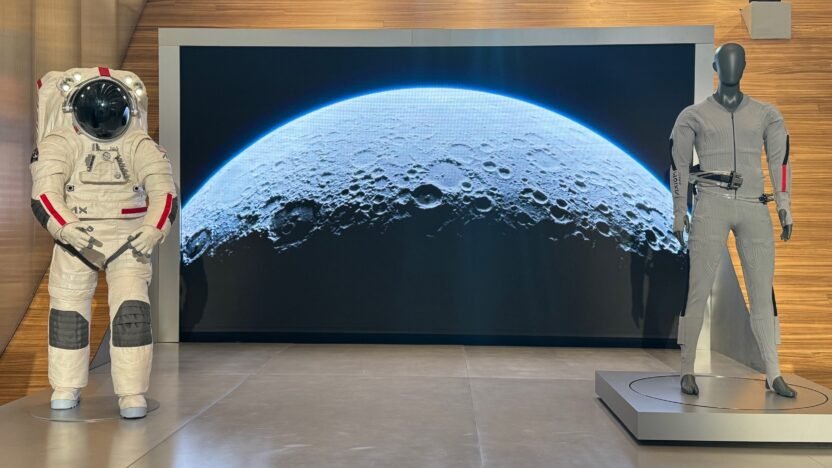
NEW YORK — Axiom Space unveiled the design of another element of the lunar spacesuit it is developing for NASA in partnership with luxury designer Prada.
During a June 7 event at a Prada store, the companies showed off the Liquid Cooling and Ventilation Garment (LCVG) that is part of the Axiom Extravehicular Mobility Unit, or AxEMU, that Axiom is developing. The AxEMU is the spacesuit astronauts will wear on the lunar surface starting with the Artemis 4 mission in 2028.
The LCVG serves as an undergarment that astronauts will wear as an inner layer of the AxEMU, providing cooling and ventilation. The suit takes advantage of Prada’s expertise in garment materials and production.
“This garment is the piece that is closest to the astronaut,” said Russell Ralston, senior vice president of spacecraft development at Axiom, noting that it connects to life support systems in the suit. “You need this garment to be comfortable, functional and enhance the safety of the overall suit.”
Compared to a similar inner layer in NASA’s current spacesuits used on the International Space Station, the LCVG features a more integrated design of tubes used for water cooling. The design of the tubes is intended to improve the efficiency of that cooling and also includes a redundant cooling line.
The material is more comfortable than that of the ISS suit, Ralston said, and uses different materials. That material is also intended to avoid any electrical charging issues given the plasma environment on the lunar surface.
He added the suit is designed to be easier to produce. “For these initial missions it’s nice to have, but if we want to move to a world where there’s thousands and millions of people flying in space, that’s a really big deal in the future.”
As with the suit’s outer layer, which Axiom unveiled at the International Astronautical Congress in Milan in October 2024, it developed the LCVG in partnership with Prada.

Lorenzo Bertelli, chief marketing officer of Prada Group, said his company was able to offer its expertise in working with soft goods as well as materials such as titanium and composites. He emphasized the company’s vertical integration and scalability.
“There is no sector in the world where there is such vertical integration like in luxury,” he said. “We have a supply chain from raw material sourcing to retail stores.”
It was Prada’s vertical integration that led Axiom not to pursue its own vertical integration when it came to the spacesuit.
“Prada leads the world in the development of soft goods for luxury items and they control all of it, as Lorenzo said, from sourcing to final product,” said Jonathan Cirtain, chief executive of Axiom. “Why would you choose to go do that on your own when you can go work with the best?”
One example of that partnership, he said, is that the companies should be able to produce garments customized for each astronaut rather than offering a discrete set of sizes.
“They’ve figured out how they can make these suits to the person and do it in a way that doesn’t impact performance or safety or cost.”
“If it is tailor-made, it is going to be immediately the biggest step in terms of comfort, mobility and so on,” Bertelli added.
Cirtain said work on AxEMU is on schedule despite a report by NASA’s Office of Inspector General in April that warned the suit might not be ready until after the end of the decade. That schedule includes delivering a qualification suit to NASA by the end of the year as well as a prototype suit next year that will be tested in space.
“If you ask NASA today, are we on track to deliver a qualification suit by the end of the year, they’d tell you yes,” he said. “Are we on track to deliver that prototype suit for demonstration mission next year? They would tell you yes, because if they were to say no, if they were to disagree with that, it would be because we were telling them that, and we are not telling them that.”
Axiom has done extensive ground testing of the suit, including the LCVG, ranging from testing the compatibility of materials used in the garment to seeing how well its cooling system works on a range of people, Ralston said. The version displayed is the third or fourth iteration of the design.
The ultimate test, though, will be in space. “The first time you put all of those elements together is the first time the suit goes out the door on orbit,” he said.
Cirtain said NASA has not yet decided whether that in-space test next year will be done on the Artemis 3 mission or on the ISS, but added the latter would be preferable.
“I think it’s more practical that it would go to the International Space Station in terms of how you would manage that,” he said, noting it would be easier to do a spacewalk from the ISS than from the airlock of one of the Human Landing System landers that will be tested in Earth orbit on Artemis 3. One option, he said, would be to test the suit on the ISS but also fly “mass models” of the suits on the landers to see how they deal with launch loads and the flight environment on those vehicles.
He emphasized he believed AxEMU will be ready in time for the Artemis 4 landing in 2028. “We are not the long pole in the tent.”