
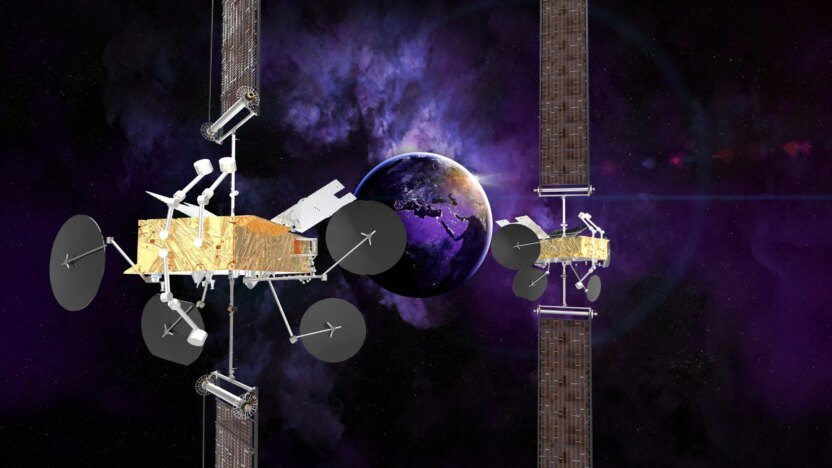
The recent cancellation of three geostationary satellites is another blow for insurers hoping their legacy cash cows would bring home much-needed income following a bruising run of claims.
SES disclosed in May it did not need the IS-41 and IS-44 satellites that Intelsat ordered before being acquired by the Luxembourg-based fleet operator last year.
A month earlier, French rival Eutelsat said it was canceling the Flexsat Americas satellite to prioritize cash for its low Earth orbit (LEO) OneWeb constellation.
All three satellites were ordered in 2022 from Europe’s Thales Alenia Space and had been slated for geostationary orbit (GEO) in the next two years.
Like other commercial operators, SES and Eutelsat tend to insure GEO satellites before waving goodbye to equipment that typically costs around $300 million on the launchpad.
These expensive giants, which can be the size of a school bus, are therefore the bedrock of the space insurance market, helping deliver roughly $500 million in premium each year over the past decade.
However, that dependence cuts both ways. In 2023, claims about three times the size of this annual premium pool sent shockwaves across the industry as underwriters pulled out, along with capacity for covering large risks.
The market has been in “cautious and considered recovery” ever since, according to Matthew Gleeson, head of space for insurance broker Aon in the U.K., with limited capacity and rates remaining at elevated levels.
Fewer claims in 2024 delivered a profit of nearly $390 million for that year, he said. An uptick in GEO launches in 2025 brought in about $650 million in income, but a $400 million claim in December helped offset what would have been another strong underwriting year.
Still, while the loss of three upcoming GEOs removes valuable premium opportunities, and launch and insurance activity this year is set to be down on 2025, the picture is not entirely bleak. The number of insured launches are set to pick up significantly in 2027 and 2028, Gleeson said, so “there’s definitely reason for positivity and cautious optimism.”
What happens after is “crystal ball time,” amid a shift toward LEO constellations and increasing popularity of cheaper GEO spacecraft closer to the size of a dishwasher. Even Viasat, a long-standing champion for massive GEO spacecraft, recently signaled a move toward smaller architecture after one of its ViaSat-3 satellites contributed to the 2023 claim tally.
Gleeson is confident insurers will be able to adapt as the broader market sets new growth records.
Future opportunities, though, may be more challenging to convert into premium income.
Setting aside SpaceX’s Starlink constellation, which famously shuns insurance, only about 5-7% of LEO satellites are covered at all, according Andrew Bonwick, head of space at specialty insurance carrier Relm.
In contrast, Bonwick said around half of all GEOs are insured at least on launch, with those uncovered usually for governments with deep pockets.The problem is that the traditional insurance product is not well-suited for proliferated constellations, Bonwick said.
“Once you get to a certain scale, the thing that needs to be insured isn’t the satellite itself — it’s the constellation as a whole [and] revenue streams.”
For Charter Space, which launched an insurance brokerage earlier this year, it’s also a question of access and high premium minimums.
“We have to get away from the bespoke model of insurance underwriting in order to accommodate a much larger flood of demand, and a much higher volume of launches — and especially novel spacecraft and smaller spacecraft,” Charter Space founder and CEO Yuk Chan said.
Opening the door to a larger pool of insurable assets could offset some of the premium income lost as large GEOs fall out of favor.
For smaller companies especially, this matters because insurance can help unlock larger funds from more conservative mainstream financial institutions, which still view space as exotic.
It also sets up the market for more complex risks further out, such as commercial space stations and lunar infrastructure, where insurers will need to look beyond launch and assess more elaborate in-orbit operations.
For Chan, that diversification cannot come soon enough.
“The traditional model of focusing just on GEO is actually, I think, a structural risk to the overall health of the insurance industry,” he said.
This article first appeared in the June 2026 issue of SpaceNews Magazine.