Across much of corporate America, artificial intelligence has become synonymous with job cuts.
In aerospace and defense, the conversation sounds very different.
Executives in these sectors increasingly see AI not as a replacement for workers but as a necessary tool for helping an overstretched industrial base build faster, scale production and compete with China.
The shift comes as the Pentagon pushes defense contractors to accelerate production of missile interceptors, satellites and other national security systems at a pace the sector has struggled to meet.
“I’ll tell you some of the companies I’ve talked to, depending on what sector of what aerospace or space economy you’re in, they’re trying to increase production by a factor of four,” said Clay Mowry, chief executive of the American Institute of Aeronautics and Astronautics.
“If you’re in the missile interceptor business right now, you’ve got to scale, and you’ve got to scale fast,” Mowry said at the recent ASCEND conference in Washington. “There is not enough workforce for that. There’s not enough people that they think that they could put in those jobs, and so they’re all scrambling.”
That scramble is helping drive a wave of investment into agentic AI systems capable of assisting with engineering, testing, supply-chain management and manufacturing workflows.
Companies hope the technology will compress development timelines that have frustrated the Pentagon for years.
Unlike traditional automation software, agentic AI systems can work across multiple engineering and manufacturing tasks at once, from design iterations to compliance documentation and production planning.
In an industry where programs can take years to move from concept to deployable hardware, even modest efficiency gains matter.
Voyager Technologies, a space and defense tech firm, has hired experts from industry and government to help implement AI-driven workflows across its national security business.
“They are driving the teams into bringing on folks that can help us actually get the technology out of the labs and into real hardware,” said Matt Magaña, who heads Voyager’s defense and national security business.
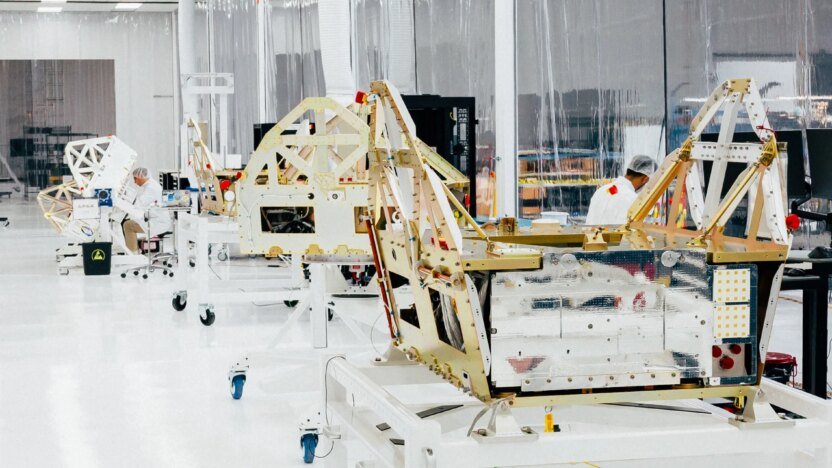
At the company’s electronics facility in Long Beach, California, “we’re developing the next generation of electronics, where we use agentic AI” to reduce development timelines, Magaña said.
The rush to adopt AI is being driven in large part by customer demands for faster delivery times as booming investment in space and defense increases pressure to get the newest technologies into operation as quickly as possible.
That pressure is especially intense in space programs, where hardware is highly specialized and qualification timelines can stretch for years.
“Space is now more affordable, but we just can’t do it fast enough,” Magaña said.
Defense officials these days talk about industrial capacity as a strategic asset in itself. It is no longer enough for the U.S. to invent advanced systems. It must also be able to produce them quickly and in meaningful numbers.
That requirement is colliding with a talent shortage.
Mowry said what he hears from aerospace and defense executives is that they cannot hire enough trained engineers, software developers and technically specialized manufacturing staff. Many firms are competing for the same small pool of workers with expertise in autonomy, machine learning and advanced systems integration.
Aerospace and defense companies in recent decades made large investments in digital engineering and simulation tools, but those systems never fundamentally solved their production bottlenecks.
Magaña said AI could prove more transformative because it affects the entire production cycle, not just the design phase.
“It doesn’t mean that humans go away,” he said. “It’s about accelerating the cycle time.”
Voyager and other companies see AI as a way to help experienced engineers move faster, manage more programs and reduce production choke points at a time when Pentagon demand is rising faster than the available workforce.
For aerospace and defense companies under pressure to deliver more satellites, missile-defense systems and military hardware on tighter timelines, AI steadily is being treated less as a workforce replacement tool than as industrial infrastructure.
This article first appeared in the June 2026 issue of SpaceNews Magazine.