WASHINGTON — NASA astronauts on the International Space Station are preparing for a spacewalk to repair a robotic arm as safety advisers raise concerns about the long-term health of the station and spacesuits.
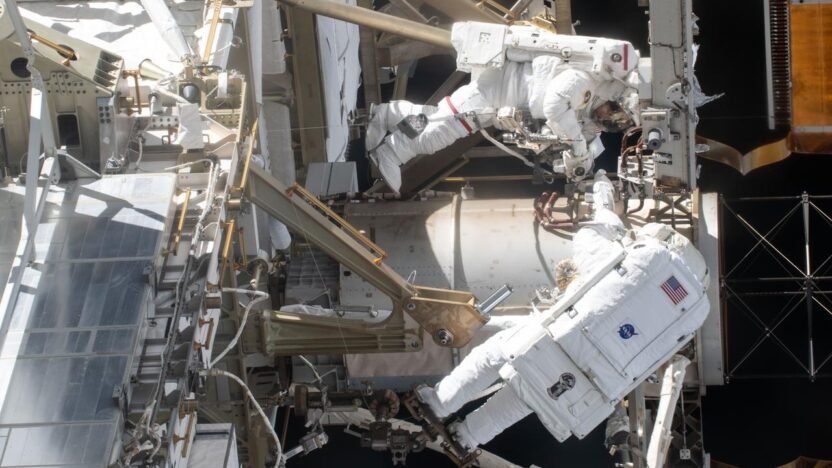
Astronauts Jessica Meir and Chris Williams are scheduled to perform a spacewalk June 30 in which they will replace a joint in the Canadarm2 robotic arm. That work will be the sole task of the spacewalk, scheduled to last six and a half hours.
Bill Spetch, NASA ISS operations and integration manager, said during a June 25 briefing that the arm did not move as expected, with an elevated motor current, during routine operations last month. Engineers determined that a wrist joint was malfunctioning, requiring replacement using a spare joint already on the station.
“Systems like Canadarm2 were designed from the beginning with replaceable components and were planned with maintenance in mind, and this is no exception,” he said.
The upcoming spacewalk, the 280th in the history of the ISS program, is the first in a series expected over the next several months. Three more are planned, starting as soon as August, to install components for a new solar array, fix electrical jumpers and replace a communications antenna.
The repairs come as the station enters its final years, with NASA still working toward a planned 2030 retirement date. The health of the station has been a focus of the Aerospace Safety Advisory Panel, or ASAP, NASA’s independent safety committee.
“The management of critical spares and resupply items has been a challenge for the aging station,” Susan Helms, chair of the committee and a former astronaut, said at a June 22 meeting of the panel. She said the committee was concerned NASA will try to ramp down funding for ISS operations ahead of its retirement.
“Temptation to reduce the ISS budget looms, but the panel would caution that such temptations should be disregarded,” she said. “As budgets decline, it is increasingly difficult for NASA to ensure the ISS risks remain manageable for day-to-day operations with enough contingency margins.”
She praised NASA ISS officials for “an outstanding job” of managing risks, but added, “The margin to do so is now reduced to alarming levels.”
Those concerns extended to the spacesuits worn on ISS spacewalks, formally known as Extravehicular Mobility Units, or EMUs. “Supply chain issues have exacerbated the EMU risk due to aging hardware, although there is a robust life-extension plan that is ongoing,” Helms said, noting there were four operational suits currently on the station.
At the spacewalk briefing, Spetch downplayed concerns about spacesuits and the overall health of the station. “We have four great suits on board right now,” he said, with a fifth going to the station this fall. “I think we’re in great shape right now for where our suits are, and we continue to work very closely with the team that maintains those suits to address anything that we see coming.”
He said there are extensive spare parts available for ISS systems, including Canadarm2, which is critical to station operations. “There’s not a time where we go, say, ‘Hey, we’re just done repairing the arm,’” he said. “Overall, the arm is critical for station operations and continued maintenance of it through to the end of life.”
Air leak status
ASAP also discussed at its meeting the June 5 incident on the ISS in which NASA ordered astronauts into the Crew Dragon spacecraft docked there while Russian cosmonauts attempted repairs to an air leak in a portion of the Zvezda service module called PrK. NASA said it was concerned the proposed repairs, which were ultimately not performed by the cosmonauts, posed an “elevated risk” to the module’s structure.
“In the view of the panel, NASA’s assessment of the situation was comprehensive and the actions taken by NASA were wholly appropriate to the elevated risk to crew safety,” Helms said.
The leaks in PrK have been an issue for several years, and Helms called them “one of the most significant safety risks” for the ISS.
NASA has said little about the issue since the incident. Asked about the status of the leaks at the spacewalk briefing, Spetch said PrK was not currently leaking.
“It’s actually at a stable pressure. We’ve reduced it on purpose down to a lower pressure, working closely with our Roscosmos colleagues on the plan forward on that,” he said.
During the June 5 incident, NASA instructed five people to go into the Crew Dragon: the four members of the Crew-12 mission that flew to the station on that spacecraft as well as Williams, who arrived at the station last November on a Soyuz spacecraft. Spetch confirmed that the Dragon has an additional seat to accommodate Williams.
“It is set up with a fifth seat installed. We’ve left it in that configuration for most of its stay on ISS at this point,” he said.