TAMPA, Fla. — Former SpaceX engineers who helped build and scale Starlink have launched a startup aiming to deliver megaconstellations for governments and companies seeking more control over space-based infrastructure.
Led by former SpaceX satellite payload engineering manager Derek Huerta, Eclipse Space emerged from stealth June 26 after being founded a year ago in Redmond, Washington, home to Starlink’s main satellite production facility.
Eclipse is preparing to deliver its first customer hardware later this year, including a prototype phased array and a telemetry, tracking and command radio, ahead of an integrated demonstration spacecraft planned for 2027.
Unlike SpaceX’s tightly controlled, vertically integrated Starlink structure, the startup is pursuing a fabless production model that Huerta likened to Apple’s iPhone approach.
Eclipse would design the satellites, own intellectual property and set up the manufacturing process, but work with regional partners to assemble them, giving customers more control and ownership without first having to build a SpaceX-scale organization.
Huerta cofounded Eclipse shortly after leaving SpaceX, which listed shares on Nasdaq earlier this month in an initial public offering that delivered a windfall for many current and former employees.
“Like a lot of early SpaceX employees, I held equity, and the IPO was good to me,” he told SpaceNews via email.
“But Eclipse isn’t a self-funded venture,” he added, pointing to undisclosed external investments led by early-stage investors such as Space Capital, Tectonic and Ubiquity.
“We are well capitalized to execute on our roadmap, including the hardware we are delivering this year and the demonstration mission,” he said.
“We are not breaking out specific figures at this stage, but we will have more to say on funding before long.”
Eclipse was cofounded by Kyle Leveque, who also cofounded Aquila Space, a remote sensing satellite maker now part of Astro Digital.
Adapting the Starlink playbook
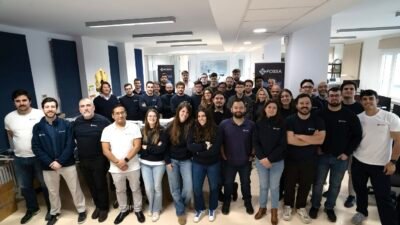
Around half of Eclipse’s roughly 30 employees joined from Starlink, Huerta said, with 13 having been part of the earliest days of the broadband constellation when it was known as Satellite Development.
“Our people developed Starlink’s phased arrays and built the supply chain that took them from prototypes to dozens of satellites a week,” Huerta said, as well as the power systems, software, modems and other manufacturing processes tied to Falcon 9’s record launch cadence.
“Between us we’ve taken nearly every subsystem of a modern megaconstellation from a whiteboard to mass production,” he added.
With more than 10,000 Starlinks in low Earth orbit, he said SpaceX has shown how satellites can be mass-produced at previously unimaginable scale and cost.
“But the more we lived inside that, the more one thing became clear,” Huerta continued. “The world was heading toward a future with a handful of these networks, all owned by a few companies and a couple of governments, and everyone else, most of the planet, would simply rent access on someone else’s terms, with someone else’s hand on the switch.
“That didn’t sit right with us. Space has become critical national infrastructure, as essential as a power grid or a telecom network. Countries don’t rent their power grids. But most of the world is on track to never own its space infrastructure, because until now the only options were renting from a foreign operator or paying more than many nations could justify to build it alone.”
Alongside commercial customers seeking proprietary connectivity and other satellite services, Eclipse is targeting governments that have been priced out of owning space infrastructure.
According to Huerta, these countries currently have few alternatives outside China for developing an end-to-end space network.
“The fact that the only real alternative right now is China is exactly why this matters,” he said.
“We don’t want America to cede its soft power in space to China, and we’re part of the answer to that.”
Artificial intelligence boost
To accelerate satellite design and engineering, Eclipse has acquired the engineering team behind Agent Studio, an AI development platform from technology firm Rendered.ai, along with an exclusive license to develop the software and an option to later buy the underlying technology.
Huerta said the deal gives Eclipse an in-house AI engineering team to build tools alongside its satellite, mechanical, electrical and radio frequency engineers.
Eclipse is already using the platform and tools built on it across its engineering efforts, including its debut spacecraft.
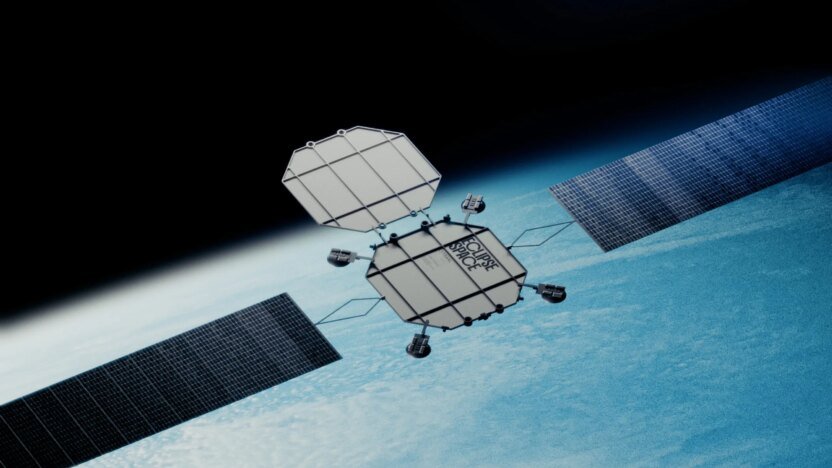
Using a bus under 100 kilograms, the demonstration satellite is designed to validate key technologies before Eclipse moves to a larger, operational “Starlink-class” model.
While the demonstrator will not include a phased array Eclipse plans to add to operational spacecraft, it is designed to put the bus to work with two in-house-built instruments: a total-ionizing-dose sensor to measure the radiation environment and a Langmuir probe to characterize the local plasma.
Huerta said operational Eclipse satellites would feature dual S-band phased arrays, E-band backhaul, V-band inter-satellite links and eight kilowatts of power, with more than 20 designed to stack on a single Falcon 9 for launch.
He said Eclipse is initially targeting direct-to-device services, in part because tackling one of the hardest engineering challenges in satellite communications forces the venture to develop core technologies it could later apply to broadband and other capabilities, including orbital data centers.
Eclipse sees a future where every nation, along with most major enterprises, will want its own constellation as satellite networks become increasingly critical infrastructure.
However, according to Huerta, meeting much of that demand at prices that make sovereign ownership realistic will not be possible through traditional in-house vertical integration.
“Vertical integration was the right answer for SpaceX’s specific problem,” he added.
“It isn’t the right answer for a world where every government and enterprise wants a constellation of its own.”