WASHINGTON — NASA is partnering with the U.S. Small Business Administration (SBA) on an effort to attract capital to invest in companies producing critical space components.
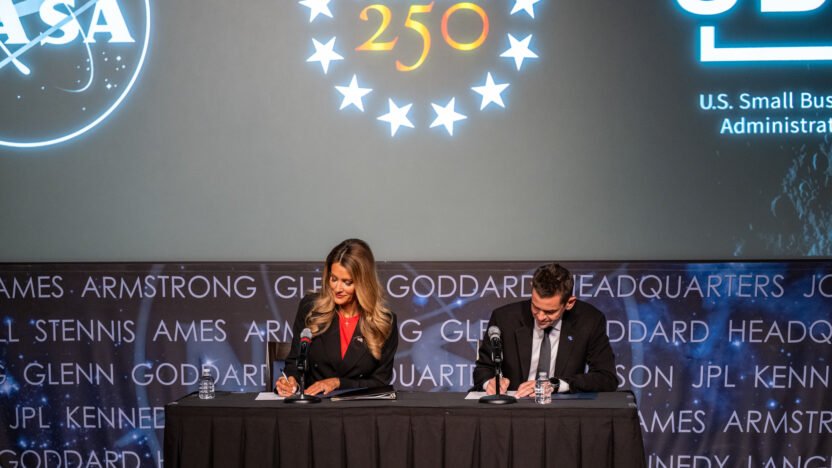
NASA and the SBA signed a memorandum of agreement last week on the partnership, leveraging an existing SBA program that supports private investment in small businesses to help companies working on technologies needed for Artemis and other key programs.
Under the agreement, NASA will identify what it calls “strategic aerospace technology focus areas” and other supply chain needs. The SBA will work to attract capital through its Small Business Investment Company, or SBIC, program, in which the SBA provides government-guaranteed loans to match private capital.
For the NASA partnership, the investment funds participating in the SBIC program will agree to commit at least 60% of the capital they invest into the focus areas identified by NASA.
“Through this partnership with NASA, the SBA is mobilizing private sector investment to fuel the small businesses, manufacturers and innovators that are driving American space dominance,” SBA Administrator Kelly Loeffler said in a statement. “By aligning capital with strategic national priorities, this exciting effort will help launch the next great era of space exploration.”
NASA announced seven focus areas for the new initiative: energy production, infrastructure and storage; nuclear power and propulsion; advanced software, avionics and communications systems; specialized materials and components; infrastructure for inhospitable environments; scaled launch infrastructure; and biomedical and life support technology.
NASA’s work on this SBA partnership will be managed by a new Office of Strategic Capital within the agency. “Through the NASA Office of Strategic Capital, this partnership with the SBA will help small businesses access the capital they need to scale, strengthen critical supply chains, rebuild America’s industrial might and deliver the outcomes necessary to ensure the United States leads the next era of space exploration,” NASA Administrator Jared Isaacman said in a statement.
The new office draws parallels to the Defense Department’s Office of Strategic Capital, established by the 2024 National Defense Authorization Act, which directed it to support companies in 31 technology areas. It offers direct loans of up to $150 million to companies to finance projects in those areas.
NASA, for now, is not providing similar loans or other direct financial support through its Office of Strategic Capital. The agency said the office will “connect businesses to funding opportunities” such as the SBA partnership.
One industry group welcomed the new office and the partnership between NASA and the SBA.
“The new partnership between NASA and the Small Business Administration and the launch of NASA’s Office of Strategic Capital are exactly the kinds of effort needed to maintain America’s leadership in space and to scale space manufacturing to meet this moment,” said Eric Fanning, president and chief executive of the Aerospace Industries Association, in a July 3 statement.
He noted a study in March by PricewaterhouseCoopers commissioned by his organization found problems with the space industry supply chain, with demand outstripping capacity and a fragile supplier base. Among its recommendations were “targeted subsidies, incentives, or focused contract awards” for new suppliers and other support to help companies cover regulatory and compliance costs of becoming suppliers for government programs.
“This initiative will reinforce the industrial base needed to take us back to the moon and unlock new discoveries, down to the smallest components,” Fanning said.