HELSINKI — China’s Tianwen-2 sample return spacecraft has arrived at Kamoʻoalewa, revealing the near Earth asteroid to be a small, elongated rocky body.
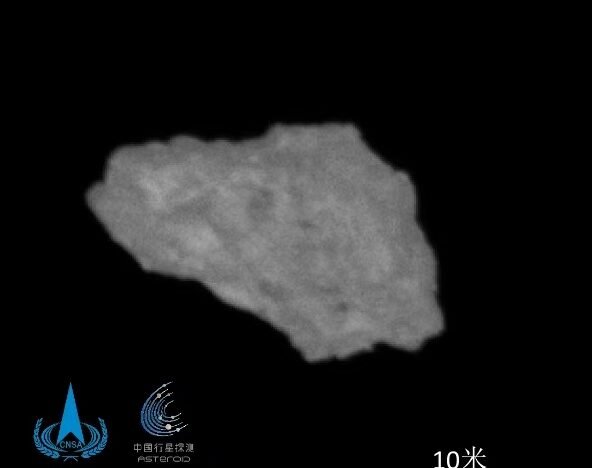
Tianwen-2 launched May 29, 2025, and traveled around 1 billion kilometers across 400 days to arrive at a distance of 20 km from the near-Earth asteroid 469219 Kamoʻoalewa (2016 HO3). The China National Space Administration (CNSA) announced the spacecraft’s arrival July 6, providing a first close up image of the asteroid.
CNSA had maintained silence regarding the mission as Tianwen-2 approached its target, while tracking by AMSAT-DL in Europe revealed that the spacecraft was in the vicinity of Kamo’oalewa and had made a series of engine burns. The July 6 statement reveals that Tianwen-2 arrived at 30,000 kilometers from the asteroid June 7, closing to 2,000 km June 19.
The 20 km station point that Tianwen-2 has now reached marks the starting point for close-proximity science operations, including global mapping and surveying and sample site selection.
“Going forward, the probe will gradually conduct more detailed scientific explorations to obtain information on the asteroid’s shape, material composition, and internal structure, providing support for preparations for sampling,” CNSA stated.
Tianwen-2 is, partly because of the unknown nature of the asteroid and its surface mechanics, capable of using three different sampling techniques, providing high levels of redundancy. These are hovering sampling, touch-and-go, and anchoring and attachment sampling, with the use of the latter dependent on suitability of the asteroid’s surface and regolith. After collecting samples, Tianwen-2 is expected to depart Kamo’oalewa in April 2027, delivering the samples via reentry capsule in late November 2027.
Tianwen-2 carries a suite of 11 science payloads for studying both Kamoʻoalewa and its later target, the comet 311P/PANSTARRS, including cameras, laser ranging, spectrometers, sounding radar and particle analyzers. It also carries the DIANA dust analyzer from Italy.
Kamoʻoalewa is an asteroid that shadows Earth in a stable quasi-satellite orbit. Ground-based observations suggested the asteroid had a diameter of between 40 and 100 meters, but the image released by CNSA suggests a diameter of just over 20 meters. This would match closely to a paper by Sharkey et al, pre-published via ArXiv July 1 and still under peer review, which estimated a diameter of around 18 meters based on observations made by the James Webb Space Telescope (JWST).
Mikael Granvik, an astronomer at the University of Helsinki and Luleå University of Technology in Sweden, told SpaceNews that the first image of Kamo’oalewa, at this early stage, “basically confirms” the high geometric albedo—a measure of surface reflectivity—suggested by the Sharkey paper, which in turn is not compatible with the low-to-moderate albedo of the moon. “So it seems that Kamo’oalewa is of asteroidal origin,” Granvik said.
Kamo’oalewa was hypothesized to have potentially been a chunk of the far side of the moon blasted into orbit by a large impactor, based on spectra from ground observations, while other theories suggested the rocky body originated in the main asteroid belt. The recent JWST observation paper also points away from the lunar-ejecta hypothesis and towards Kamo’oalewa potentially being a rare E-type silicate asteroid.
The mission is the second in the Tianwen program, with Tianwen-1—China’s first interplanetary mission—successfully landing a rover on Mars in 2021. Tianwen-3 is a Mars sample return mission scheduled to launch in late 2028, while Tianwen-4 is a Jupiter system mission with a focus and potential landing on the Galilean moon Callisto.