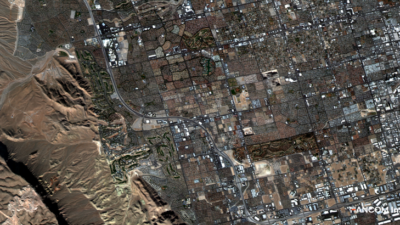

DENVER — The U.S. spy satellite agency is expanding its use of commercial Earth observation data, signing new agreements with three companies as it refines how private-sector capabilities are integrated into intelligence operations.
The National Reconnaissance Office said EarthDaily Analytics, Iceye and Pixxel have been selected under its Commercial Solutions Opening program, a contracting approach designed to evaluate emerging commercial technologies with fewer upfront requirements.
Speaking May 4 at the GEOINT Symposium, Pete Muend, director of the NRO’s Commercial Systems Program Office, said the agency is “very eager to see” how the partnerships develop as it assesses both the companies’ satellite constellations and the data they produce.
The NRO, which builds and operates the U.S. government’s classified intelligence satellite fleet, has turned to commercial providers to supplement its own systems. The shift reflects both the rapid growth of private Earth observation companies and the government’s need for faster, more diverse streams of data.
Under the Commercial Solutions Opening, or CSO, the agency does not prescribe a detailed technical solution. Instead, it defines a mission need and allows companies to propose how they would meet it. Awards are structured in stages. An initial phase focuses on modeling and simulation to determine whether a proposed data source could support intelligence missions. A second phase moves to on-orbit evaluation, where the NRO assesses data quality, latency and how well the information integrates into analytic workflows.
The three companies represent different sensing approaches the NRO is seeking to combine.
Pixxel, which has operations in India and the United States, is building a hyperspectral imaging constellation and launched its first three satellites in January. Hyperspectral imaging captures data across hundreds of narrow spectral bands, allowing analysts to identify materials based on their unique spectral signatures, a capability that can reveal details not visible in conventional imagery.
Iceye, already a provider of synthetic aperture radar data to the NRO since 2022, received a new award focused on non-traditional radio-frequency sensing using its radar satellites.
EarthDaily Analytics is deploying an optical and multispectral constellation designed for global coverage, with an emphasis on high revisit rates and consistent, calibrated data. The company launched six satellites on May 3 as part of that effort, aiming to produce data that can be analyzed over time with minimal variation.
“By combining multi-phenomenology data from providers like EarthDaily, Iceye and Pixxel, we can deliver more comprehensive, timely insights for national security, environmental monitoring, disaster response and humanitarian efforts,” Muend said.
The awards are part of the NRO’s broader Strategic Commercial Enhancements program, launched in 2022 to systematically test commercial data sources across different sensing types, including radar, radio frequency, hyperspectral and electro-optical imagery. Early contracts were issued through traditional Broad Agency Announcements, which defined more specific technical requirements. The CSO model, introduced more recently, allows for continuous submissions and faster evaluation cycles.
The agency has used these contracts to assess performance before committing to larger-scale data purchases.
Cybersecurity standards
As the number of commercial partners grows, cybersecurity has become a central concern.
“We spend a lot of time talking about cybersecurity,” Muend said.
The NRO operates some of the most sensitive systems in the U.S. government, and officials say the challenge is no longer limited to protecting a closed network of government satellites. The agency is now managing a broader ecosystem that includes private companies with varying levels of cybersecurity maturity.
To address that, the NRO has established a three-tier classification system for vendors: unverified providers, industrial standard providers and secure providers. Companies at the lowest tier meet baseline federal requirements but may not be trusted with more sensitive tasks. Industrial standard providers meet higher cybersecurity thresholds comparable to those required for defense contractors. Secure providers are capable of operating at the secret level.
“These are companies that have their own private architecture,” Muend said. “We want to enable that and utilize that … but that doesn’t mean we don’t care about cybersecurity. We care very greatly.”
Muend said Iceye’s U.S. subsidiary has been elevated from an unverified provider to an industrial standard provider after implementing additional protections.
“Of their own accord, they implemented all the cyber protections to get to that industrial standard provider level,” he said.
The classification system is intended to ensure that data can move quickly between government and commercial systems without exposing sensitive information.
“Of course, the whole point is to make sure the data can go back and forth between the government and private industry at speed and appropriately protected,” Muend said, adding that the system is working so far and the agency expects to expand participation further.