WASHINGTON — Amazon will fly its largest number of broadband satellites to date later this month on the first Ariane 6 launch to use upgraded boosters.
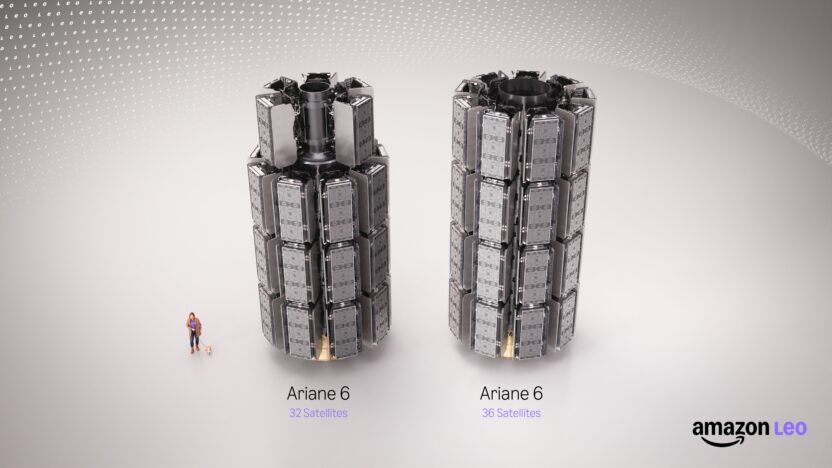
Amazon announced June 5 that it will fly 36 Amazon Leo satellites on an Ariane 64 launch from French Guiana scheduled for June 17. The LE-03 mission, as designated by Amazon, will be the third consecutive Ariane 6 launch to carry Amazon satellites, after launches in February and April.
The LE-03 mission, though, will be the first Ariane 6 to use P160C solid rocket boosters, upgraded versions of the P120C boosters used on previous Ariane 6 launches. The P160C boosters are 1 meter longer than the P120C boosters, and the four boosters combined enable the rocket to increase its low Earth orbit payload performance by more than two metric tons.
That allows Amazon to fly more satellites on this launch: 36, compared with the 32 carried on the two previous Ariane 6 flights.
“Increasing our payload capacity to 36 satellites per mission is the result of extensive engineering collaboration between our team and Arianespace,” said Melissa Wuerl, director of launch systems at Amazon Leo, in a statement. “The upgraded P160C boosters give us the performance margin to do that confidently, and we’re already looking ahead to further optimizations as we continue building out Amazon Leo.”
“The upgraded P160C boosters are bringing exactly the performance gains we designed them for, and LE-03 will be our most ambitious launch together yet,” said David Cavaillolès, chief executive of Arianespace, in a statement.

The LE-03 mission will carry the most Amazon Leo satellites of any launch. The company has flown 27 to 29 satellites on Atlas 5 launches and 24 on Falcon 9 launches.
The company had expected to set the record for the most Amazon Leo satellites on another launch this month, with a Blue Origin New Glenn rocket scheduled to carry 48 satellites in early June. However, the rocket for that mission exploded on the launch pad May 28 during a static-fire test, causing significant damage to the pad and grounding the rocket until at least the end of this year.
Amazon is also waiting for the first launch of United Launch Alliance’s Vulcan rocket with Amazon Leo satellites on board. That rocket has not flown since a February mission for the U.S. Space Force, when one of its solid rocket boosters suffered an anomaly.
ULA has been stacking a Vulcan rocket for its first Amazon Leo mission, which will use a new version of the Centaur upper stage optimized for low Earth orbit missions. Neither Amazon nor ULA has announced a date for that launch, and ULA said after the May 29 launch of an Atlas 5 carrying Amazon Leo satellites that its next launch will be another Atlas 5 mission for Amazon Leo in July.
Amazon Leo has launched 331 satellites to date, just over 10% of the planned constellation of 3,232 satellites. The company is far short of a July 30 deadline in its Federal Communications Commission license to have at least 50% of its constellation in orbit.
The company filed a request in January to either extend that deadline by 24 months or waive it entirely, citing launch delays. The FCC has not yet ruled on the request.