HELSINKI — SSC Space and Firefly have set a 2028 target for the first orbital launch from Esrange, with key infrastructure and regulatory pieces falling into place.
The companies announced the timeline during a press briefing in Stockholm, June 30, following a string of milestones that include construction progress at Launch Complex 3C, a new bilateral agreement streamlining U.S.-Swedish launch licensing and a $21.5 million (SEK 209 million) contract with Sweden’s defense procurement agency.
The companies are targeting a first launch of the Firefly Alpha rocket from Launch Complex 3C at Esrange, near Kiruna, northern Sweden, in 2028. Infrastructure progress includes completing the launch control center, payload processing facility, launch vehicle integration building, tracking and control systems and security and storage facilities at LC-3C.
“Adding an orbital launch capability to mainland Europe will strengthen the continent’s capabilities and competitiveness in the commercial space arena, while contributing to greater resilience and strategic autonomy within the defense domain,” said Charlotta Sund, CEO and group president of SSC Space.
Final construction is underway on the launch pad and ground support equipment, the last major infrastructure milestone before Alpha’s debut from the site.
The infrastructure progress follows a Memorandum of Cooperation signed in April between the Swedish National Space Agency (SNSA) and the U.S. Federal Aviation Administration, intended to streamline launch licensing and establish a shared regulatory framework for flying American vehicles from Swedish territory. That agreement builds on a Technology Safeguards Agreement (TSA) between the two countries, with Sweden only the sixth country to sign such a pact with the U.S., which governs the export of sensitive American launch technology.
“Today we’re celebrating the realization of critical transatlantic partnerships that are enabling Firefly’s global launch expansion strategy, starting in Sweden,” said Jason Kim, CEO of Firefly Aerospace. “We’re proud to partner with SSC Space and work collaboratively with U.S. and Swedish agencies to provide European customers with a dedicated orbital launch capability using our flight-proven Alpha rocket.
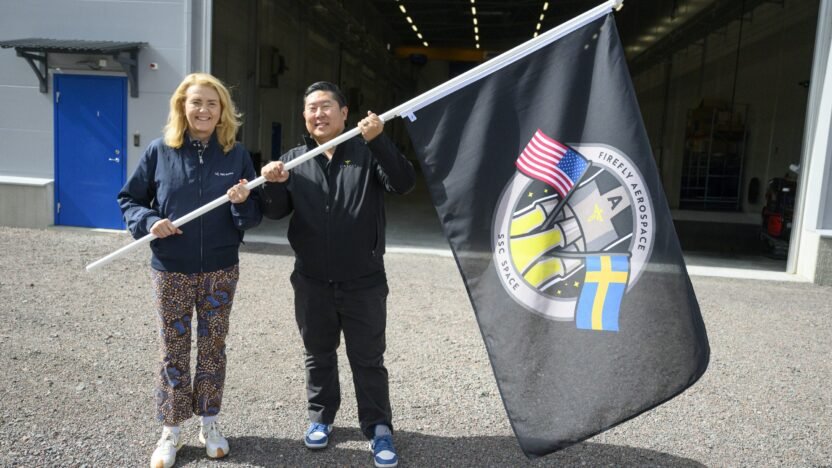
“Yesterday we celebrated that progress by placing a flag at the exact location where Alpha will lift off from, and that’s a symbolic reminder that this vision is quickly becoming a reality.”
Sund said most of the remaining regulatory work on the Swedish side has been resolved. “I would say that all those hindrances or obstacles are now clarified,” she said, adding that SSC’s near-term focus shifts to integrating payloads for the Alpha rocket. SNSA is also standing up a new internal unit to handle launch licensing ahead of 2028, she said, calling the dialogue with the agency long-standing and not expecting major obstacles, though documentation requirements remain to be finalized.
SSC’s clearest near-term customer is the Swedish military. The SEK 209 million agreement with the Swedish Defense Materiel Administration (FMV) will let the Swedish Armed Forces launch its own satellites from Esrange using Alpha. Sund characterized the funding as supporting pre-launch capability-building rather than purchasing fixed launch services outright, and declined to specify an expected cadence of military missions beyond saying discussions with FMV and the Swedish Armed Forces are ongoing.
For Firefly, Esrange is the first deployment of what Kim calls a “launch as a franchise” strategy. Rather than building and operating sites itself, the company partners with established international operators to fly its Alpha rocket from their facilities. Firefly is evaluating a similar arrangement with Space Cotan to launch Alpha from Hokkaido Spaceport in Japan.
Alpha has flown seven times to date, all from Vandenberg Space Force Base in California. The most recent flight, Alpha Flight 7, launched March 11 carrying a Lockheed Martin demonstrator payload and validating a second-stage engine relight ahead of the vehicle’s Block II upgrade. Kim said Flight 7 reduced risk for Block II’s consolidated avionics and batteries and streamlined manufacturing, with Flight 8, the first Block II mission, targeted for late summer. Firefly is also developing an East Coast launch site at Wallops Island, Virginia.
Esrange sits roughly 200 km north of the Arctic Circle, a location both companies pitched as well suited to sun-synchronous and polar orbits in demand for national-security and commercial missions. Trajectories from the site head north and northeast over Norway and the Barents Sea, with a dogleg maneuver around Tromsø, which is the only sizable settlement near the flight corridor.
Viraj LeBailley, U.S. Embassy Deputy Chief of Mission, pointed to a recently signed U.S.-Sweden technology and prosperity agreement identifying space as one of eight areas of strategic cooperation. LeBailley also flagged concerns that a forthcoming EU Space Act could create regulatory friction for American launch providers operating from European soil.
“I understand that in Brussels there are discussions of an EU Space Act. Partners like the United States and Sweden must not let regulations have unintended negative consequences for the tremendous potential of the space sector,” LeBailley said during the press briefing. When asked for clarification on this point, embassy officials said they would follow up with additional detail.
The EU Space Act, still in early stages of the European legislative process, has not been finalized, and its provisions affecting non-EU launch providers remain unclear.