
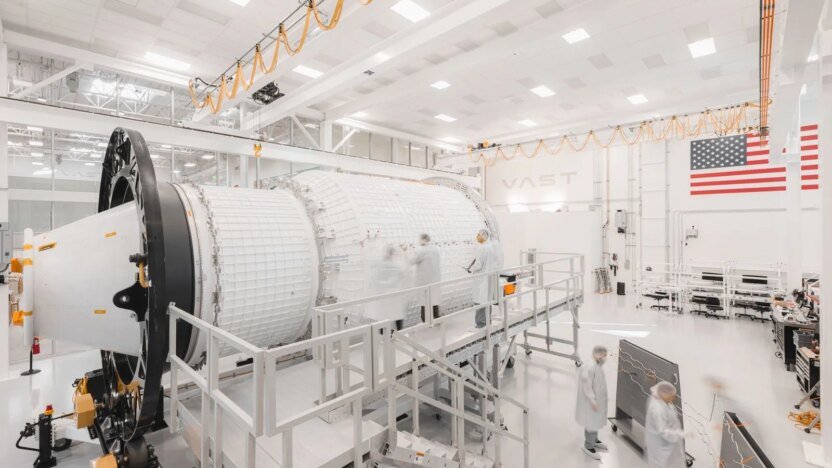
WASHINGTON — Commercial space station developer Vast has named the former president and chief executive of The Aerospace Corp. as an adviser while the company awaits the next phase of a key NASA program.
Vast announced June 30 that Steve Isakowitz has joined the company as an adviser. Isakowitz retired from The Aerospace Corp. last year after nine years as its leader. Earlier in his career, he held senior positions at Virgin Galactic, NASA, the Department of Energy and the Office of Management and Budget.
That experience, he noted in an interview, spans much of the history of the International Space Station. “It’s had an incredible run, but that run is coming to an end, and it’s coming to an end at a really exciting time for the industry,” he said of the ISS.
Vast is among the companies proposing to build commercial stations that would serve as successors to the ISS, with NASA as one of multiple customers. “I think that really opens up the possibilities of what was the original vision of the International Space Station to find partnerships and look for opportunities for research, manufacturing and so on,” he said.

He felt Vast was well-positioned in the commercial space station market, citing its “end-to-end capability” to build and operate systems as well as an iterative approach to development, starting with its Haven-Demo satellite last year. “Between the vision, the capability and the team, that’s what really got me excited,” he said.
“We reached out at the first opportunity, given obviously his experience,” said Max Haot, chief executive of Vast, in an interview. “He has a deep understanding not only of our business technically but also of key stakeholders, including the government.”
The appointment comes as Vast awaits details about the next phase of NASA’s Commercial Low Earth Orbit Destinations, or CLD, program. After announcing in March that the agency was considering a revised approach to supporting commercial space stations with a government-owned “core module” attached to the ISS, NASA said June 1 it was abandoning that option.
The agency said it would stick with plans announced last year to provide multiple awards for the next phase of the CLD program so that companies can develop and demonstrate their stations. NASA said at the time it expected to release a draft request for proposals by the end of the month, although it had not done so as of the end of the day June 29.
Haot said the release of the draft RFP might be delayed a week or two. “What we hear is that the plan will be to have at least two winners, which we fully support,” he said. “It’s in the best interest of America and NASA to keep competition and to have redundancy.”
Isakowitz added he was not surprised by the changes in the CLD program in recent months. “I haven’t seen a program at NASA that hasn’t whipsawed from different positions as they try to figure things out, and that’s probably the right thing to do to get sort of comfortable with the approach,” he said.
He said he thought NASA was “on the right track” now but would need to see the details when the draft RFP is released. “But once that RFP goes out, the government’s really got to commit and stay consistent,” he said. “We’re in a new world now where, with industry bringing its own investments to bear on this, consistency is really critical.”
Haot said he appreciated that NASA followed through on its commitment to listen to industry and modify its CLD plans but regretted the lost time as the 2030 deadline for retiring the ISS looms. “We’ve lost a bit of time, that’s the main unfortunate thing,” he said. “We got a few more gray hairs and lost a bit of time.”