SAN FRANCISCO – NewOrbit Space, a UK startup developing satellites for very low Earth orbit (VLEO), has raised $18.5 million in a Series A investment round.
With the funding, announced June 8, NewOrbit will conduct its first mission, attract customers seeking access to VLEO and establish a facility to produce affordable satellites, Anatolii Papulov, NewOrbit CEO and co-founder, told SpaceNews.
“We are building this as a product for anyone to come to us and say, ‘We want to fly at VLEO, bring us there,’” Papulov said. “We will integrate it and fly there.”
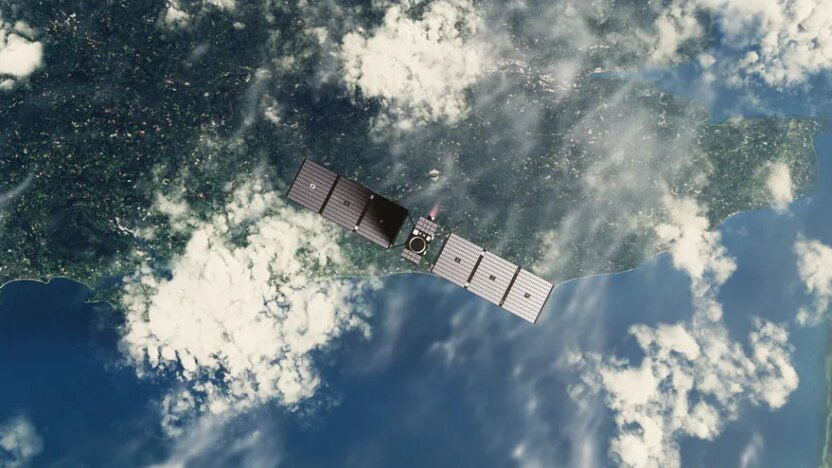
NewOrbit plans to provide commercial service beginning with its first flight in 2028. From an altitude of 250 to 300 kilometers, the startup based in Reading, England, will demonstrate the extensive benefits of operating so low, Papulov said.
By flying below 300 kilometers, “NewOrbit will be able to offer the highest quality satellite imagery available today, 20x cheaper than conventional satellites alongside faster data speeds,” according to the news release. “These advantages have the potential to unlock new paradigms in the space economy such as 5G direct-to-device connectivity from space and live HD video.”

Foundational shift
Voyager Ventures led NewOrbit’s “oversubscribed” funding round. Participants included Atlantic VC, Lifeline Ventures, Illusian, Custos Family Office, David Kirk, former Nvidia chief scientist, and Tier Mobility co-founder and former CEO Lawrence Leuschner.
“VLEO is the next foundational shift in the global space industry,” Matthew Blain, Voyager Ventures partner, said in a statement. “The technology will unlock order of magnitude improvements in earth observation at a fraction of the cost today.”
NewOrbit was co-founded in 2021 by Papulov and Ruslan Rakhimov, former senior researcher at Moscow-based Avant Space Systems. Rakhimov is NewOrbit’s chief technology officer.
Papulov and Rakhimov joined forces to tackle the problems that have prevented extensive VLEO operations: aerodynamic drag, atomic oxygen and aerodynamic torque.
“You actually have to build entirely new satellites to fly at this altitude,” Papulov said. “Almost every subsystem is different.”
For example, NewOrbit is developing and testing proprietary electronics, thermal, structure, mechanics and control technology as well as embedded software and air-breathing electric propulsion systems based on gridded ion thrusters.
Strategic sovereign asset
In NewOrbit’s NEO Production Complex, scheduled to open next year, the startup plans to ramp up from an initial capacity of 10 satellites annually to several satellites per week. NewOrbit’s goal is to establish “Europe’s largest dedicated VLEO production facility and a strategic industrial asset within the continent’s sovereign space ecosystem,” according to the news release.
“VLEO is one of the few genuinely new commercial categories remaining in space,” Jean-Jacques Dordain, former European Space Agency director general and a NewOrbit advisor, said in a statement. “Opening it requires a rare combination of engineering excellence and institutional discipline. NewOrbit has both, and the fact that this category is being defined from the UK is significant for European space.”
Another NewOrbit advisor, Sir Chris Deverell, former commander of UK Joint Forces, said in a statement that VLEO will be “a critical layer of future space infrastructure, supporting both commercial and national security missions.”