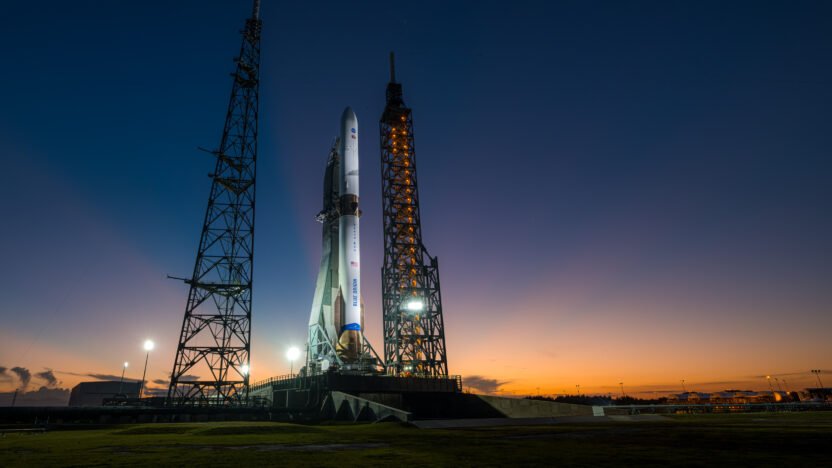
AMSTERDAM — A Blue Origin New Glenn rocket exploded on its launch pad at Cape Canaveral, Florida, during a May 28 hotfire test, destroying the rocket and causing extensive pad damage.
The New Glenn rocket for the company’s next mission exploded at about 9 p.m. Eastern during a static-fire test of the rocket’s first stage. Blue Origin and the Space Force’s Space Launch Delta 45, which operates the Eastern Range, confirmed there were no injuries.
Videos show a massive explosion just after the stage’s seven BE-4 engines ignited for the test, creating a giant fireball that enveloped the pad at Launch Complex 36.
“We experienced an anomaly during today’s hotfire test. All personnel have been accounted for. We will provide updates as we learn more,” Blue Origin said in a statement on social media shortly after the explosion.
“All personnel are accounted for and safe. It’s too early to know the root cause but we’re already working to find it,” added the company’s founder, Jeff Bezos. “Very rough day, but we’ll rebuild whatever needs rebuilding and get back to flying. It’s worth it.”
It was not immediately clear how much damage the explosion did to LC-36, the New Glenn pad. Videos show one of the lightning towers by the pad was no longer standing, with the expectation of significant damage to other pad infrastructure.
New Glenn’s first stage uses methane and liquid oxygen propellants, a combination whose explosive yield has been under study for several years by NASA, the FAA and the Space Force to determine the size of exclusion zones during launches and hot-fire tests. Those propellants are also used by vehicles such as SpaceX’s Starship and United Launch Alliance’s Vulcan, and there had been concerns that the size of those vehicles would result in damage to neighboring pads in the event of an explosion.
This is the worst explosion at Cape Canaveral since a Falcon 9 exploded at Space Launch Complex 40 during preparations for a static-fire test in September 2016. That explosion caused significant damage to the pad, which did not return to service until December 2017.
The vehicle was on the pad for tests ahead of the rocket’s return to flight on the NG-4 mission, carrying a set of Amazon Leo broadband satellites. The Federal Aviation Administration gave its approval for launches to resume May 22 after Blue Origin completed an investigation into the NG-3 launch April 19, when an upper-stage malfunction stranded a satellite in a low, unrecoverable orbit.
Blue Origin had been preparing for an NG-4 launch as soon as June 4. The vehicle is now grounded for an extended period as Blue Origin both investigates the explosion and repairs damage to the launch pad.
The explosion is a blow not just to Blue Origin but also to customers and to NASA. Amazon was Blue Origin’s largest commercial customer, with 24 launches under contract to deploy at least 48 satellites per launch for its 3,200-satellite Amazon Leo constellation. AST SpaceMobile, whose BlueBird 7 satellite was lost on the NG-3 mission, also planned to rely heavily on New Glenn for deploying its direct-to-device satellites.
New Glenn is also playing a major role in NASA’s Artemis lunar exploration effort. A New Glenn launch was scheduled for this fall carrying Blue Origin’s first Blue Moon Mark 1 uncrewed lunar lander, a mission that NASA renamed Moon Base 1 at a May 26 event. A second Blue Moon Mark 1 lander is planned to launch in 2027 carrying NASA’s VIPER lunar rover.
At the May 26 event, NASA announced it awarded a contract to Blue Origin to launch two rovers, being developed by Astrolab and Lunar Outpost, on separate Blue Moon Mark 1 landers. Those landers would be delivered to the moon before the Artemis 4 crewed lunar landing in 2028.
The explosion could also affect Artemis 3, the next crewed mission. It is intended to operate in low Earth orbit, docking with prototypes of SpaceX’s Starship and Blue Origin’s Blue Moon Mark 2 crewed lunar landers. Blue Moon Mark 2, like Mark 1, is designed to launch on New Glenn.
“Spaceflight is unforgiving, and developing new heavy-lift launch capability is extraordinarily difficult,” NASA Administrator Jared Isaacman said in a statement after the explosion. “We will work with our partners to support a thorough investigation of this anomaly, assess near-term mission impacts, and get back to launching rockets. We will provide information on any impacts to the Artemis and Moon Base programs as it becomes available.”