
HELSINKI — A number of new Chinese state-led and commercial rockets are set for debuts and fresh first stage recovery attempts in the coming weeks and months.
Rockets from state-owned CASC and commercial entities including Galactic Energy, iSpace and more are in various states of readiness for long-awaited debuts. The surge is a part of China’s aim to greatly boost its access to space and ease a launch bottleneck for its megaconstellation projects.
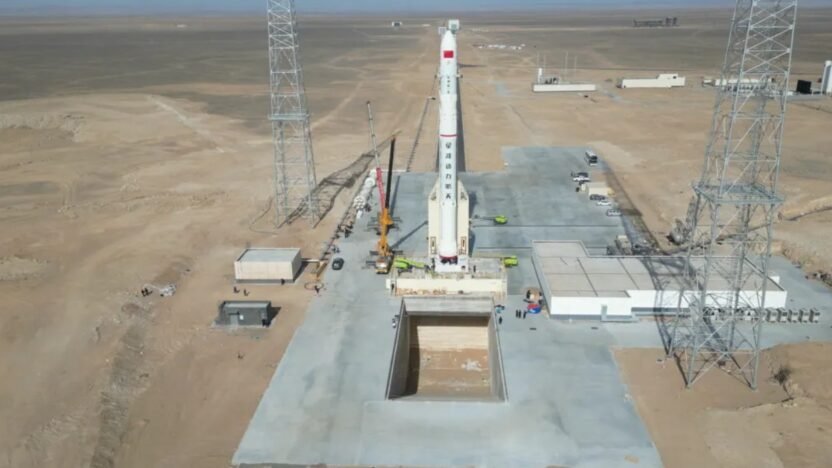
CASC’s Long March 12B recently appeared vertical on the pad at Dongfeng Commercial Space Innovation Test Zone within the Jiuquan Satellite Launch Center, northwest China, according to unofficial images. It follows a January hotfire test of the new rocket.
The images indicate landing legs, but it is unclear if there will be an attempt at a first stage recovery when the launcher gets its test flight.
The newly unveiled Long March 12B has been described as a 4-meter-diameter class rocket but uses kerosene and liquid oxygen propellant mix with a “20-ton-class low Earth orbit carrying capacity,” though actual figures for expendable and recoverable modes are unknown.
It follows but is distinct from the Long March 12A, which debuted in December 2025 but made a failed recovery attempt and uses methane-liquid oxygen engines. It is capable of delivering around 9,000 kilograms to low Earth orbit (LEO), or around 6,000 kg when the first stage is recovered and has a dedicated landing site downrange of Jiuquan.
No solid date for the Long March 12B launch is available, but earlier statements indicate a planned launch with the first half of 2026.
Pallas-1
Also vertical at the Dongfeng Commercial Space Innovation Test Zone is commercial firm Galactic Energy’s first liquid propellant launcher, the Pallas-1. The company recently completed phase 1 of its Pallas series rocket launch site for the rocket, according to a May 26 statement. Pallas-1 has hardware for reusability such as landing legs and grid fins, but an attempted recovery is not expected on the first flight.
Pallas-1 is a kerosene-liquid oxygen rocket, is to be able to carry 7,000 kilograms of payload to a 200-km LEO having previously been stated to be 8,000 kg. Galactic Energy also aims to debut the much larger Pallas-2 (20,000 kg to LEO) in 2027.
Hyperbola-3
Hyperbola-3’s first-stage sea recovery landing system has completed full-profile ground verification, following a full-scale drop and shock test using a flight-weight first stage and landing legs, iSpace stated May 17.
The rocket is officially expected to make its debut before the end of 2026, though recent milestones suggest the company could be ready earlier. The company secured a record D++ funding round of $729 million in February.
Long March 10B
The Long March 10B is a cargo version of the human-rated Long March 10A for the new Mengzhou crew spacecraft and a key to China’s lunar landing ambitions. The 10B rolled out to Wenchang Commercial LC-2 in early April, completed a successful wet dress rehearsal, and is targeting a booster sea-catch recovery attempt using a ship equipped with a wire recovery system. An expected test flight did not immediately follow, with suggestions that an attempt may not come until July. The launch will be significant given its relation to China’s crewed lunar launch architecture.
The Long March 10A is expected to debut later this year, following a successful in-flight abort test for Mengzhou which doubled as a simulated first stage flight and powered descent.
Zhuque-3
Another recovery attempt is expected from Landspace with its Zhuque-3, which successfully reached orbit late last year but failed in the latter stages of a first stage powered descent and landing attempt. The company stated it is targeting Q2 2026 for its second attempt, with suggestions the rocket has shipped to Jiuquan, but there is no sign of an imminent launch attempt at present.
The expected flights follow two debuts of new Chinese rockets in March and April this year, with the Tianlong-3 from Space Pioneer failing to reach orbit, while CAS Space’s Kinetica-2 was successful.